Ch.20 - Nuclear Chemistry
McMurry - Chemistry 8th Edition
McMurry8th EditionChemistryISBN: 9781292336145Non è quello che usi tu?Cambia libro di testo
Capitolo 20, Problema 96

How much energy (in kJ/mol) is released in the fusion reaction with 2H and 3He?

Guida verificata passo dopo passo
1
insert step 1> Identify the fusion reaction: The fusion reaction involves deuterium (\(^2\text{H}\)) and helium-3 (\(^3\text{He}\)). The balanced chemical equation for this reaction is: \(^2\text{H} + ^3\text{He} \rightarrow ^4\text{He} + ^1\text{H}\).
insert step 2> Determine the mass defect: Calculate the mass of the reactants and the mass of the products. The mass defect is the difference between the total mass of the reactants and the total mass of the products.
insert step 3> Convert the mass defect to energy: Use Einstein's equation \(E = mc^2\) to convert the mass defect into energy. Here, \(m\) is the mass defect and \(c\) is the speed of light (\(3.00 \times 10^8\) m/s).
insert step 4> Convert the energy from joules to kilojoules: Since the energy calculated will be in joules, convert it to kilojoules by dividing by 1000.
insert step 5> Calculate the energy per mole: Use Avogadro's number (\(6.022 \times 10^{23}\) mol\(^{-1}\)) to convert the energy from per reaction to per mole. This will give you the energy released in kJ/mol.

Risposta video verificata per un problema simile:

Questa soluzione video è stata consigliata dai nostri tutor come utile per risolvere questo problema.
Durata del video:
10m

Concetti chiave

Ecco i concetti essenziali che devi comprendere per rispondere correttamente alla domanda.

Nuclear Fusion

Nuclear fusion is a process where two light atomic nuclei combine to form a heavier nucleus, releasing energy in the process. This reaction is the source of energy for stars, including the sun, and occurs under extreme temperature and pressure conditions. In the context of the question, the fusion of deuterium (2H) and helium-3 (3He) is a specific reaction that releases a significant amount of energy.
Video consigliato:
Percorso guidato
02:06
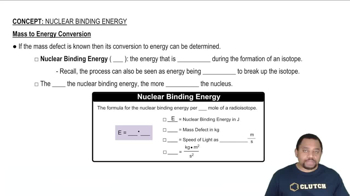
Nuclear Binding Energy

Energy Release in Reactions

The energy released during a nuclear fusion reaction can be quantified in terms of kilojoules per mole (kJ/mol). This energy is derived from the mass difference between the reactants and the products, as described by Einstein's equation E=mc². Understanding how to calculate this energy is crucial for determining the efficiency and feasibility of fusion as an energy source.
Video consigliato:
Percorso guidato
01:51
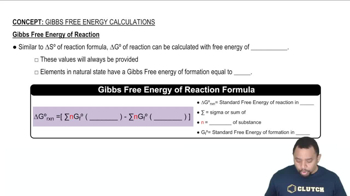
Gibbs Free Energy of Reactions

Binding Energy

Binding energy is the energy required to disassemble a nucleus into its constituent protons and neutrons. In fusion reactions, the binding energy of the resulting nucleus is greater than that of the original nuclei, leading to the release of energy. This concept is essential for understanding why fusion reactions can produce energy and how the stability of nuclei affects the energy output.
Video consigliato:
Percorso guidato
02:06
Nuclear Binding Energy