Potassium ion, K+, is present in most foods and is an essen-tial nutrient in the human body. Potassium-40, however, which has a natural abundance of 0.0117%, is radioactive with t1/2 = 1.25 x 10^9 years. What is the decay constant of 40K? How many 40K+ ions are present in 1.00 g of KCl? How many disintegration/s does 1.00 g of KCl undergo?
Guida verificata passo dopo passo
1
Step 1: Calculate the decay constant (\( \lambda \)) using the half-life formula: \( \lambda = \frac{\ln(2)}{t_{1/2}} \). Substitute the given half-life of Potassium-40, \( t_{1/2} = 1.25 \times 10^9 \) years, into the formula.
Step 2: Determine the number of moles of KCl in 1.00 g. Use the molar mass of KCl (approximately 74.55 g/mol) to convert grams to moles: \( \text{moles of KCl} = \frac{1.00 \text{ g}}{74.55 \text{ g/mol}} \).
Step 3: Calculate the number of K+ ions in 1.00 g of KCl. Since each formula unit of KCl contains one K+ ion, use Avogadro's number (\( 6.022 \times 10^{23} \) ions/mol) to find the total number of K+ ions: \( \text{number of K+ ions} = \text{moles of KCl} \times 6.022 \times 10^{23} \).
Step 4: Determine the number of \( ^{40}K^+ \) ions. Use the natural abundance of Potassium-40 (0.0117%) to find the fraction of K+ ions that are \( ^{40}K^+ \): \( \text{number of } ^{40}K^+ \text{ ions} = \text{number of K+ ions} \times 0.000117 \).
Step 5: Calculate the disintegration rate (activity) in disintegrations per second. Use the decay constant and the number of \( ^{40}K^+ \) ions: \( \text{Activity} = \lambda \times \text{number of } ^{40}K^+ \text{ ions} \).
Risposta video verificata per un problema simile:
Questa soluzione video è stata consigliata dai nostri tutor come utile per risolvere questo problema.
Durata del video:
5m
Guarda un video:
0 Commenti
Concetti chiave
Ecco i concetti essenziali che devi comprendere per rispondere correttamente alla domanda.
Radioactive Decay and Decay Constant
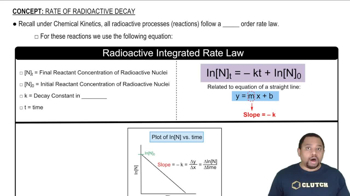
Radioactive decay is the process by which an unstable atomic nucleus loses energy by emitting radiation. The decay constant (λ) is a probability measure of the decay of a radioactive isotope, indicating the fraction of a sample that decays per unit time. It is related to the half-life (t1/2) of the isotope by the equation λ = ln(2) / t1/2, allowing us to calculate the decay constant from the half-life.
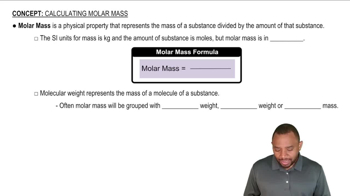
Molar mass is the mass of one mole of a substance, typically expressed in grams per mole (g/mol). For potassium chloride (KCl), the molar mass can be calculated by adding the atomic masses of potassium (K) and chlorine (Cl). Avogadro's number (6.022 x 10^23) is the number of particles in one mole of a substance, enabling the conversion between grams and the number of ions or molecules.
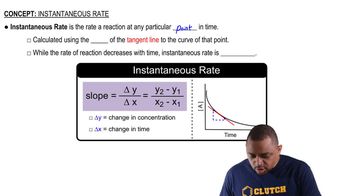
The disintegration rate refers to the number of radioactive decays occurring per unit time, often expressed in disintegrations per second (dps). This rate can be calculated using the decay constant and the number of radioactive nuclei present in a sample. By multiplying the decay constant by the number of 40K nuclei in 1.00 g of KCl, one can determine how many disintegrations occur per second in that sample.


 Guida verificata passo dopo passo
 03:00
03:00