
Ch.20 - Nuclear Chemistry
McMurry - Chemistry 8th Edition
McMurry8th EditionChemistryISBN: 9781292336145Non è quello che usi tu?Cambia libro di testo
Capitolo 20, Problema 60

Radioactive decay exhibits a first-order rate law, rate = -∆N/∆t = kN, where N denotes the number of radio-active nuclei present at time t. The half-life of strontium-90, a dangerous nuclear fission product, is 29 years. (a) What fraction of the strontium-90 remains after three half-lives?

Guida verificata passo dopo passo
1
Understand the concept of half-life: The half-life of a radioactive substance is the time it takes for half of the radioactive nuclei to decay.
Identify the number of half-lives passed: In this problem, three half-lives have passed for strontium-90.
Calculate the fraction remaining after each half-life: After one half-life, half of the original amount remains, which is \(\frac{1}{2}\) of the original amount.
Apply the half-life decay successively for each half-life: After the second half-life, half of the remaining amount from the first half-life will decay, leaving \(\frac{1}{2} \times \frac{1}{2} = \frac{1}{4}\) of the original amount.
Calculate the fraction remaining after the third half-life: Similarly, after the third half-life, half of the remaining amount from the second half-life will decay, leaving \(\frac{1}{4} \times \frac{1}{2} = \frac{1}{8}\) of the original amount.

Risposta video verificata per un problema simile:

Questa soluzione video è stata consigliata dai nostri tutor come utile per risolvere questo problema.
Durata del video:
1m

Concetti chiave

Ecco i concetti essenziali che devi comprendere per rispondere correttamente alla domanda.

First-Order Kinetics

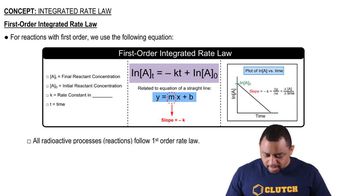
First-order kinetics refers to a reaction rate that is directly proportional to the concentration of one reactant. In the context of radioactive decay, this means that the rate at which a radioactive substance decays is dependent on the number of undecayed nuclei present. The mathematical representation, rate = -∆N/∆t = kN, indicates that as the number of nuclei decreases, the rate of decay also decreases.
Video consigliato:
Percorso guidato
02:29
First-Order Reactions

Half-Life

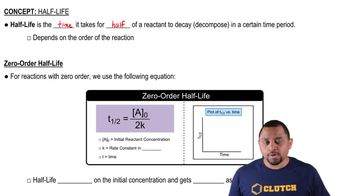
The half-life of a radioactive substance is the time required for half of the radioactive nuclei in a sample to decay. This concept is crucial for understanding the decay process, as it provides a consistent measure of how quickly a substance will lose its radioactivity. For strontium-90, with a half-life of 29 years, after each half-life, the remaining quantity of the substance is halved.
Video consigliato:
Percorso guidato
02:17
Zero-Order Half-life

Exponential Decay

Exponential decay describes the process by which a quantity decreases at a rate proportional to its current value. In radioactive decay, this means that after each half-life, the amount of the substance remaining can be calculated using the formula N(t) = N0 * (1/2)^(t/T), where N0 is the initial quantity, t is the elapsed time, and T is the half-life. This concept helps in determining the fraction of strontium-90 remaining after multiple half-lives.
Video consigliato: