Ch.21 - Transition Elements and Coordination Chemistry
McMurry - Chemistry 8th Edition
McMurry8th EditionChemistryISBN: 9781292336145Non è quello che usi tu?Cambia libro di testo
Capitolo 21, Problema 21.140a

Cobalt(III) trifluoroacetylacetonate, Co(tfac)3, is a sixc oordinate, octahedral metal chelate in which three planar, bidentate tfac ligands are attached to a central Co atom:
(a) Draw all possible diastereoisomers and enantiomers of Co(tfac)3.

Guida verificata passo dopo passo
1
Step 1: Understand the structure of the complex. Cobalt(III) trifluoroacetylacetonate, Co(tfac)3, is an octahedral complex with three bidentate ligands. Each tfac ligand coordinates to the cobalt center through two donor atoms, forming a chelate ring.
Step 2: Recognize that the octahedral geometry allows for different spatial arrangements of the ligands. In this case, the ligands are identical, so we need to consider the possible arrangements that lead to different stereoisomers.
Step 3: Identify the possible diastereoisomers. In an octahedral complex with three identical bidentate ligands, there are two main types of isomers: facial (fac) and meridional (mer). The fac isomer has all three ligands occupying adjacent positions, while the mer isomer has them spread out, with one ligand opposite the other two.
Step 4: Consider the enantiomers. Enantiomers are non-superimposable mirror images. In the case of Co(tfac)3, the fac isomer can have enantiomers because it lacks a plane of symmetry, whereas the mer isomer is typically achiral.
Step 5: Draw the structures. For the fac isomer, draw two mirror image structures to represent the enantiomers. For the mer isomer, draw a single structure, as it does not have enantiomers. Ensure that the drawings clearly show the spatial arrangement of the ligands around the cobalt center.

Risposta video verificata per un problema simile:

Questa soluzione video è stata consigliata dai nostri tutor come utile per risolvere questo problema.

Concetti chiave

Ecco i concetti essenziali che devi comprendere per rispondere correttamente alla domanda.

Coordination Chemistry

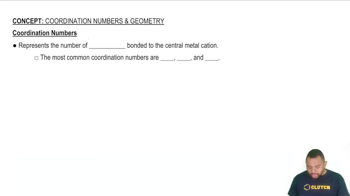
Coordination chemistry involves the study of complex compounds formed between metal ions and ligands. In this context, cobalt(III) is the central metal ion, and the trifluoroacetylacetonate (tfac) ligands are bidentate, meaning each ligand can form two bonds with the metal. Understanding the geometry and bonding of these complexes is crucial for analyzing their stereochemistry.
Video consigliato:
Percorso guidato
00:27
Coordination Numbers

Stereoisomerism

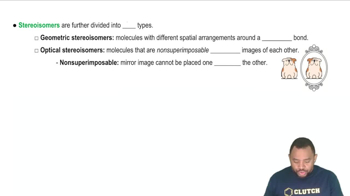
Stereoisomerism refers to the phenomenon where compounds have the same molecular formula and connectivity but differ in the spatial arrangement of atoms. In the case of Co(tfac)3, the arrangement of the bidentate ligands around the cobalt center can lead to different spatial configurations, resulting in diastereoisomers and enantiomers, which are essential for understanding the compound's chemical behavior.
Video consigliato:

Chirality

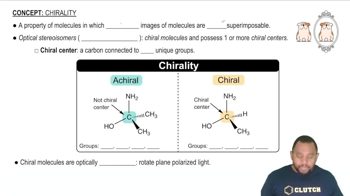
Chirality is a property of a molecule that makes it non-superimposable on its mirror image, akin to left and right hands. In coordination complexes like Co(tfac)3, chirality arises when the arrangement of ligands creates distinct enantiomers. Identifying chiral centers and understanding their implications is vital for drawing the correct stereoisomers and recognizing their potential optical activity.
Video consigliato: