Ch.21 - Transition Elements and Coordination Chemistry
McMurry - Chemistry 8th Edition
McMurry8th EditionChemistryISBN: 9781292336145Non è quello che usi tu?Cambia libro di testo
Capitolo 21, Problema 21.85a

Six isomers for a square planar palladium(II) complex that contains two Cl-and two SCN-ligands are shown below.


(a) Which structures are cis-trans isomers?
(b) Which structures are linkage isomers?

Guida verificata passo dopo passo
1
Identify the coordination geometry of the complex. Since it is a square planar complex, the ligands are arranged in a square plane around the central metal ion.
For part (a), determine the cis-trans isomers by examining the positions of the Cl- and SCN- ligands. In cis isomers, similar ligands are adjacent, while in trans isomers, similar ligands are opposite each other.
List the possible arrangements of the ligands around the palladium center, considering the positions of Cl- and SCN- ligands to identify which are cis and which are trans.
For part (b), identify linkage isomers by considering the different ways the SCN- ligand can bind to the metal center. SCN- can bind through the sulfur atom (thiocyanato) or the nitrogen atom (isothiocyanato).
List the structures where SCN- is bound through different atoms, indicating the presence of linkage isomers.

Risposta video verificata per un problema simile:

Questa soluzione video è stata consigliata dai nostri tutor come utile per risolvere questo problema.

Concetti chiave

Ecco i concetti essenziali che devi comprendere per rispondere correttamente alla domanda.

Cis-Trans Isomerism

Cis-trans isomerism is a type of stereoisomerism where isomers differ in the spatial arrangement of ligands around a central atom. In square planar complexes, 'cis' refers to ligands being adjacent to each other, while 'trans' indicates that they are opposite. This arrangement affects the physical and chemical properties of the complex, making it essential to identify these isomers in coordination chemistry.
Video consigliato:
Percorso guidato
3:33
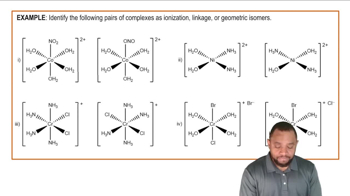
Isomerism in Coordination Complexes Example

Linkage Isomerism

Linkage isomerism occurs when a ligand can coordinate to a metal center in more than one way. For example, the thiocyanate ion (SCN-) can bind through the sulfur atom (thiocyanato) or the nitrogen atom (isothiocyanato). This type of isomerism is significant in coordination compounds as it can lead to different chemical behaviors and reactivities.
Video consigliato:
Percorso guidato
2:14
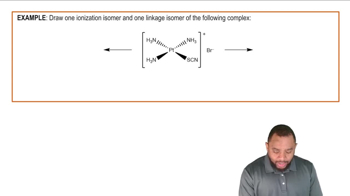
Isomerism in Coordination Complexes Example

Square Planar Geometry

Square planar geometry is a molecular shape that occurs in certain coordination complexes, particularly those involving d8 metal ions like palladium(II). In this geometry, four ligands are arranged at the corners of a square around the central metal atom, leading to specific spatial arrangements that influence isomerism. Understanding this geometry is crucial for analyzing the isomers of the palladium complex in question.
Video consigliato:
Percorso guidato
02:07
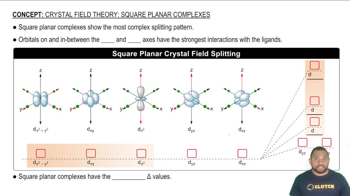
Square planar complexes show the most complex splitting pattern.
Pratica correlata
Domanda del libro di testo

What is the systematic name for each of the following coordination compounds? 

(a) Cs[FeCl4]

(b) [V(H2O)6](NO3)3

162
views

Domanda del libro di testo

What is the systematic name for each of the following ions?

(a) [MnCl4]2-

(b) [Ni(NH3)6]2+

132
views
Domanda del libro di testo

Two first-series transition metals have three unpaired electrons in complex ions of the type [MCl4]2-.

(a) What are the oxidation state and the identity of M in these complexes?

(b) Draw valence bond orbital diagrams for the two possible ions.

(c) Based on common oxidation states of first-series transition metals (Figure 21.6), which ion is more likely to exist?

<QUESTION REFERENCES FIGURE 21.6>

77
views
Domanda del libro di testo

Assign a systematic name to each of the following ions.

(c) [Fe(H2O)5NCS]2+

(d) [Cr(NH3)2(C2O4)2]-

221
views
Domanda del libro di testo

There are two possible [M(OH)4]- complexes of first-series transition metals that have three unpaired electrons.

(a) What are the oxidation state and the identity of M in these complexes?

(b) Using orbital diagrams, give a valence bond description of the bonding in each complex.

(c) Based on common oxidation states of first-series transition metals (Figure 21.6), which [M(OH)4]- complex is more likely to exist? 

<QUESTION REFERENCES FIGURE 21.6>-

106
views
Domanda del libro di testo

For each of the following complexes, draw a crystal field energy-level diagram, assign the electrons to orbitals, and predict the number of unpaired electrons.

(a) [Pt(NH3)4]2+ (square planar)

109
views