

Ch.21 - Transition Elements and Coordination Chemistry
McMurry - Chemistry 8th Edition
McMurry8th EditionChemistryISBN: 9781292336145Non è quello che usi tu?Cambia libro di testo
Capitolo 21, Problema 21.107

Draw a crystal field energy-level diagram, assign the electrons to orbitals, and predict the number of unpaired electrons for each of the following.
(a) [Cu(en)3]2+
(b) [FeF6]2-
(c) [Co(en)3]3+ (low spin) 

Guida verificata passo dopo passo
1
Identify the oxidation state and electron configuration of the central metal ion for each complex.
Determine the geometry and crystal field splitting pattern (octahedral or tetrahedral) for each complex.
For each complex, draw the crystal field energy-level diagram, showing the splitting of the d-orbitals.
Assign the electrons to the d-orbitals according to the electron configuration and the crystal field splitting pattern.
Count the number of unpaired electrons in the d-orbitals for each complex.

Risposta video verificata per un problema simile:

Questa soluzione video è stata consigliata dai nostri tutor come utile per risolvere questo problema.

Concetti chiave

Ecco i concetti essenziali che devi comprendere per rispondere correttamente alla domanda.

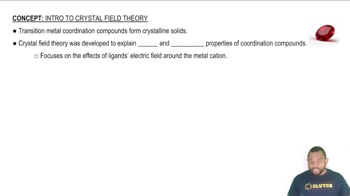
Crystal Field Theory

Crystal Field Theory (CFT) explains how the arrangement of ligands around a central metal ion affects the energy levels of its d-orbitals. In an octahedral field, for example, the d-orbitals split into two energy levels: the lower-energy t2g and the higher-energy eg orbitals. This splitting is crucial for determining the electronic configuration of transition metal complexes and predicting their magnetic properties.
Video consigliato:
Percorso guidato
01:18
The study of ligand-metal interactions helped to form Ligand Field Theory which combines CFT with MO Theory.

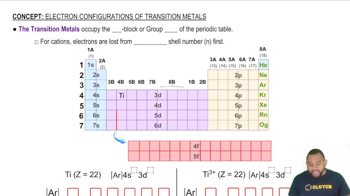
Electron Configuration and Orbital Filling

The electron configuration of a transition metal complex is determined by the number of d-electrons and the ligand field strength. Electrons fill the lower energy orbitals first, following Hund's rule and the Pauli exclusion principle. Understanding how to assign electrons to the split d-orbitals based on the ligand type (strong or weak field) is essential for predicting the number of unpaired electrons in a complex.
Video consigliato:
Percorso guidato
02:15
Electron Orbital Diagrams

Magnetic Properties of Transition Metal Complexes

The magnetic properties of transition metal complexes are influenced by the presence of unpaired electrons. Complexes with unpaired electrons exhibit paramagnetism, while those with all paired electrons are diamagnetic. By analyzing the electron configuration derived from the crystal field energy-level diagram, one can predict whether a complex will be paramagnetic or diamagnetic, which is important for understanding its chemical behavior.
Video consigliato:
Percorso guidato
03:12
Transition Metals
Pratica correlata
Domanda del libro di testo

The amount of paramagnetism for a first-series transition metal complex is related approximately to its spin-only magnetic moment. The spin-only value of the magnetic moment in units of Bohr magnetons (BM) is given by sqrt(n(n + 2)), where n is the number of unpaired electrons. Calculate the spin-only value of the magnetic moment for the 2+ ions of the first-series transition metals (except Sc) in octahedral complexes with (a) weak-field ligands and (b) strong-field ligands. For which electron configurations can the magnetic moment distinguish between high-spin and low-spin electron configurations?

99
views
Domanda del libro di testo

Which of the following complexes are paramagnetic?

(a) [Mn(CN)6]3-

(b) [Zn(NH3)4]2+ (tetrahedral)

(c) [Fe(CN)6]4-

(d) [FeF6]4-

101
views
Domanda del libro di testo

Based on the wavelength of maximum absorption of the cobalt complexes, arrange the following ligands in a spectrochemical series from weakest-field to strongest-field ligand. 

(a) Cl- < NCS- < H2O < NH3 

(b) Cl- < NCS- < H2O < NH3 

(c) H2O < Cl- < NH3 < NCS-

(d) Cl- < H2O < NCS- < NH3

105
views
Domanda del libro di testo

What hybrid orbitals are used by the metal ion and how many unpaired electrons are present the complex ion [VCl4]- with tetrahedral geometry?

(a) sp3; 2 unpaired electrons

(b) sp3; 3 unpaired electrons

(c) sp3d2; 3 unpaired electrons

(d) sp3d2; 4 unpaired electrons

88
views
Domanda del libro di testo

For each of the following complexes, draw a crystal field energy-level diagram, assign the electrons to orbitals, and predict the number of unpaired electrons. 

(a) [CrF6]3-

(b) [V(H2O)6]3+

(c) [Fe(CN)6]3-

96
views
Domanda del libro di testo

What is the systematic name for each of the following coordination compounds? 

(c) [Co(NH3)4Br2]Br

(d) Cu(gly)2

170
views