Ch.21 - Transition Elements and Coordination Chemistry
McMurry - Chemistry 8th Edition
McMurry8th EditionChemistryISBN: 9781292336145Non è quello che usi tu?Cambia libro di testo
Capitolo 21, Problema 72a

Draw the structure of the following complexes. What are the oxidation state, coordination number, and coordination geometry of the metal in each?
(a) Na[Au(CN)2]

Guida verificata passo dopo passo
1
Step 1: Identify the components of the complex Na[Au(CN)_2]. The complex consists of a sodium ion (Na^+) and a complex ion [Au(CN)_2]^-.
Step 2: Determine the oxidation state of the metal. The cyanide ion (CN^-) has a charge of -1. Since there are two cyanide ions, their total charge is -2. The sodium ion (Na^+) balances the charge of the complex ion, so the charge on the complex ion [Au(CN)_2]^- is -1. Therefore, the oxidation state of gold (Au) is +1.
Step 3: Determine the coordination number of the metal. The coordination number is the number of ligand donor atoms bonded to the metal. In [Au(CN)_2]^-, there are two cyanide ligands, so the coordination number of Au is 2.
Step 4: Determine the coordination geometry of the metal. With a coordination number of 2, the geometry is typically linear. Therefore, the coordination geometry around Au in [Au(CN)_2]^- is linear.
Step 5: Draw the structure of the complex. The structure of [Au(CN)_2]^- is linear with Au in the center and CN groups on either side: CN-Au-CN. The sodium ion (Na^+) is not part of the coordination sphere but balances the charge of the complex.

Risposta video verificata per un problema simile:

Questa soluzione video è stata consigliata dai nostri tutor come utile per risolvere questo problema.

Concetti chiave

Ecco i concetti essenziali che devi comprendere per rispondere correttamente alla domanda.

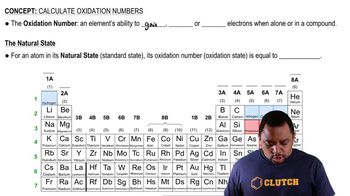
Oxidation State

The oxidation state of an element in a compound indicates the degree of oxidation of that element, reflecting the number of electrons lost or gained. In coordination complexes, the oxidation state of the metal can be determined by considering the charges of the ligands and the overall charge of the complex. For example, in Na[Au(CN)2], the cyanide ion (CN-) has a -1 charge, which helps in calculating the oxidation state of gold (Au).
Video consigliato:
Percorso guidato
02:42
Oxidation Numbers

Coordination Number

The coordination number refers to the number of ligand atoms that are directly bonded to the central metal atom in a coordination complex. It is crucial for understanding the structure and stability of the complex. In the case of Na[Au(CN)2], the coordination number is 2, as there are two cyanide ligands coordinating to the gold atom.
Video consigliato:
Percorso guidato
00:27
Coordination Numbers

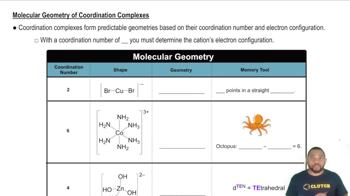
Coordination Geometry

Coordination geometry describes the spatial arrangement of the ligands around the central metal atom in a coordination complex. This geometry is influenced by the coordination number and the steric and electronic properties of the ligands. For Na[Au(CN)2], with a coordination number of 2, the geometry is linear, which is typical for complexes with two ligands.
Video consigliato:
Percorso guidato
02:40
Molecular Geometry of Coordination Complexes