Ch.21 - Transition Elements and Coordination Chemistry
McMurry - Chemistry 8th Edition
McMurry8th EditionChemistryISBN: 9781292336145Non è quello che usi tu?Cambia libro di testo
Capitolo 21, Problema 69

What is the formula, including the charge, for each of the following complexes?
(a) An iron(III) complex with six water ligands
(b) A nickel(II) complex with two ethylenediamine and two bromide ligands
(c) A platinum(II) complex with two chloride and two ammonia ligands

Guida verificata passo dopo passo
1
Identify the oxidation state of the central metal ion in each complex. For (a) iron(III) indicates an oxidation state of +3 for iron. For (b) nickel(II) indicates an oxidation state of +2 for nickel. For (c) platinum(II) indicates an oxidation state of +2 for platinum.
Determine the charge contributed by each ligand. Water (H2O) is a neutral ligand, so it contributes 0 charge. Ethylenediamine (en) is also a neutral ligand, contributing 0 charge. Bromide (Br-) is an anionic ligand, contributing -1 charge per ligand. Chloride (Cl-) and ammonia (NH3) are similar, with chloride contributing -1 charge per ligand and ammonia being neutral.
Calculate the total charge of the complex by adding the charges of the central metal ion and the ligands. For (a), since all ligands are neutral, the charge of the complex is the same as the charge of the metal ion. For (b) and (c), sum the charges of the metal ion and the charges contributed by the anionic ligands.
Write the formula of the complex by placing the central metal ion first, followed by the ligands in alphabetical order within square brackets. The overall charge of the complex is written outside the brackets.
For (a), the formula is [Fe(H2O)6]^{3+}. For (b), the formula is [Ni(en)2Br2]^{2+}. For (c), the formula is [Pt(NH3)2Cl2]^{2+}.

Risposta video verificata per un problema simile:

Questa soluzione video è stata consigliata dai nostri tutor come utile per risolvere questo problema.

Concetti chiave

Ecco i concetti essenziali che devi comprendere per rispondere correttamente alla domanda.

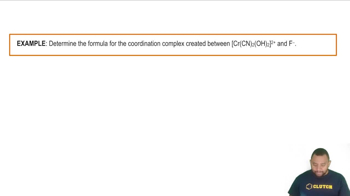
Coordination Complexes

Coordination complexes consist of a central metal atom or ion bonded to surrounding molecules or ions called ligands. The nature of these bonds can vary, with ligands donating electron pairs to the metal, forming coordinate covalent bonds. Understanding the structure and bonding in these complexes is essential for determining their chemical formulas and charges.
Video consigliato:
Percorso guidato
00:43
Coordination Complexes Example

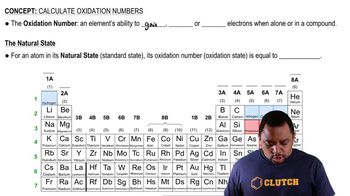
Oxidation States

The oxidation state of a metal in a coordination complex indicates its charge and is crucial for writing the correct formula. For example, iron(III) indicates an oxidation state of +3, while nickel(II) indicates +2. Knowing the oxidation states helps in balancing the overall charge of the complex when combined with the charges of the ligands.
Video consigliato:
Percorso guidato
02:42
Oxidation Numbers

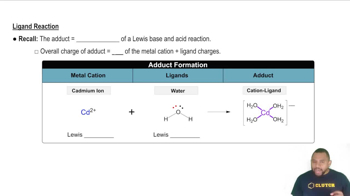
Ligands and Their Charges

Ligands can be neutral or charged, and their nature affects the overall charge of the coordination complex. Water (H2O) is a neutral ligand, while ethylenediamine (en) is also neutral, but bromide (Br-) and chloride (Cl-) are negatively charged. Identifying the type and charge of each ligand is essential for accurately determining the total charge of the complex.
Video consigliato:
Percorso guidato
01:53
Ligand Reaction