
Ch.21 - Transition Elements and Coordination Chemistry
McMurry - Chemistry 8th Edition
McMurry8th EditionChemistryISBN: 9781292336145Non è quello che usi tu?Cambia libro di testo
Capitolo 21, Problema 21.131b

Nickel(II) complexes with the formula NiX2L2, where X is Cl- or N-bonded NCS- and L is the monodentate triphenylphosphine ligand P(C6H5)3, can be square planar or tetrahedral.
(b) If NiCl2L2 is paramagnetic and Ni(NCS)2L2 is diamagnetic, which of the two complexes is tetrahedral and which is square planar?

Guida verificata passo dopo passo
1
Understand the terms: Paramagnetic substances have unpaired electrons, while diamagnetic substances have all electrons paired.
Recall that square planar complexes often result in low-spin configurations, leading to paired electrons, while tetrahedral complexes are usually high-spin, resulting in unpaired electrons.
Consider the electronic configuration of Nickel(II), which is [Ar] 3d^8.
In a square planar geometry, the d-orbitals split such that the electrons pair up, leading to a diamagnetic complex.
In a tetrahedral geometry, the d-orbitals split differently, often resulting in unpaired electrons, leading to a paramagnetic complex.

Risposta video verificata per un problema simile:

Questa soluzione video è stata consigliata dai nostri tutor come utile per risolvere questo problema.

Concetti chiave

Ecco i concetti essenziali che devi comprendere per rispondere correttamente alla domanda.

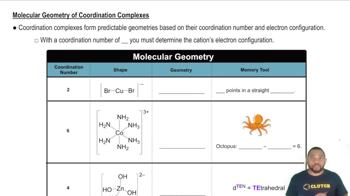
Coordination Geometry

Coordination geometry refers to the spatial arrangement of ligands around a central metal atom in a complex. Nickel(II) complexes can adopt different geometries, such as square planar or tetrahedral, depending on the number and type of ligands coordinated to the metal. The geometry influences the electronic properties and reactivity of the complex.
Video consigliato:
Percorso guidato
02:40
Molecular Geometry of Coordination Complexes

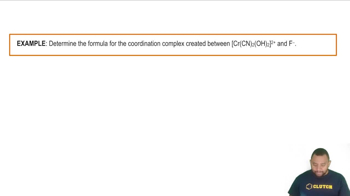
Magnetism in Coordination Complexes

The magnetic properties of coordination complexes are determined by the presence of unpaired electrons. A paramagnetic complex has unpaired electrons, resulting in a net magnetic moment, while a diamagnetic complex has all electrons paired, leading to no net magnetic moment. Understanding these properties helps in predicting the geometry of the complexes based on their magnetic behavior.
Video consigliato:
Percorso guidato
00:43
Coordination Complexes Example

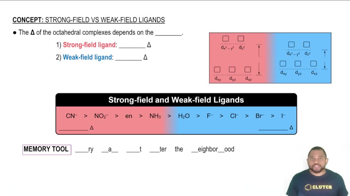
Ligand Field Theory

Ligand field theory explains how the arrangement of ligands around a metal ion affects its electronic structure and energy levels. In square planar complexes, the d-orbitals split in a way that can stabilize unpaired electrons, leading to paramagnetism, while tetrahedral complexes have a different splitting pattern that can lead to diamagnetism. This theory is crucial for understanding the electronic configurations of metal complexes.
Video consigliato:
Percorso guidato
02:40
Strong-Field Ligands result in a large Δ and Weak-Field Ligands result in a small Δ.
Pratica correlata
Domanda del libro di testo

The percent iron in iron ore can be determined by dissolving the ore in acid, then reducing the iron to Fe2+, and finally titrating the Fe2+ with aqueous KMnO4. The reaction products are Fe2+ and Mn2+.

(c) Draw a crystal field energy-level diagram for the reactants and products, MnO4-, 3Fe1H2O2642+, 3Fe1H2O2643+, and 3Mn1H2O2642+, and predict the number of unpaired electrons for each.

101
views
Domanda del libro di testo

What is the systematic name for each of the following ions? 

(c) [Co(CO3)3]3-

(d) [Pt(en)2(SCN)2]2+

117
views
Domanda del libro di testo

For each of the following complexes, draw a crystal field energy-level diagram, assign the electrons to orbitals, and predict the number of unpaired electrons.

(c) [Co(NCS)4]2- (tetrahedral)

112
views
Domanda del libro di testo

For each of the following complexes, describe the bonding using valence bond theory. Include orbital diagrams for the free metal ion and the metal ion in the complex. Indicate which hybrid orbitals the metal ion uses for bonding, and specify the number of unpaired electrons. 

(b) [Ag(NH3)2]+

128
views
Domanda del libro di testo

For each of the following complexes, draw a crystal field energy-level diagram, assign the electrons to orbitals, and predict the number of unpaired electrons.

(b) [MnCl4]2- (tetrahedral)

107
views
Domanda del libro di testo

Spinach contains a lot of iron but is not a good source of dietary iron because nearly all the iron is tied up in the oxalate complex [Fe(C2O4)3]3-.

(c) Draw a crystal field energy-level diagram for [Fe(C2O4)3]3-, and predict the number of unpaired electrons. (C2O42- is a weak-field bidentate ligand.)

107
views