Ch.21 - Transition Elements and Coordination Chemistry
McMurry - Chemistry 8th Edition
McMurry8th EditionChemistryISBN: 9781292336145Non è quello che usi tu?Cambia libro di testo
Capitolo 21, Problema 21-113b

For each of the following complexes, draw a crystal field energy-level diagram, assign the electrons to orbitals, and predict the number of unpaired electrons.
(b) [MnCl4]2- (tetrahedral)

Guida verificata passo dopo passo
1
Identify the oxidation state and electron configuration of the metal ion. For Mn in [MnCl4]2-, the oxidation state of Mn is +2. The electron configuration of Mn2+ is [Ar] 3d5.
Understand the crystal field splitting in a tetrahedral complex. In tetrahedral complexes, the d orbitals split into two sets due to the approach of ligands along the axes between the x, y, and z axes. The lower energy set is the e orbitals (dxy, dxz, dyz), and the higher energy set is the t2 orbitals (dx^2-y^2, dz^2).
Distribute the electrons among the split d orbitals. Start filling the lower energy e orbitals first, following Hund's rule (maximize the number of unpaired electrons with parallel spins in degenerate orbitals).
Count the number of unpaired electrons. Since each of the three e orbitals will contain one electron and the two t2 orbitals will contain one electron each, all five electrons remain unpaired.
Predict the magnetic properties based on the number of unpaired electrons. A complex with five unpaired electrons, like [MnCl4]2-, is expected to be paramagnetic.

Risposta video verificata per un problema simile:

Questa soluzione video è stata consigliata dai nostri tutor come utile per risolvere questo problema.
Durata del video:
4m

Concetti chiave

Ecco i concetti essenziali che devi comprendere per rispondere correttamente alla domanda.

Crystal Field Theory

Crystal Field Theory (CFT) explains how the arrangement of ligands around a central metal ion affects the energy levels of its d-orbitals. In a tetrahedral complex like [MnCl4]2-, the d-orbitals split into two sets: the lower energy e orbitals and the higher energy t2 orbitals. This splitting is crucial for determining the electronic configuration and magnetic properties of the complex.
Video consigliato:
Percorso guidato
01:18
The study of ligand-metal interactions helped to form Ligand Field Theory which combines CFT with MO Theory.

Tetrahedral Coordination

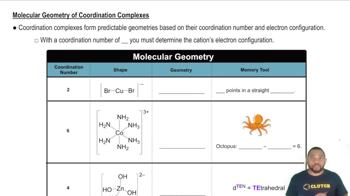
In tetrahedral coordination, a central metal ion is surrounded by four ligands positioned at the corners of a tetrahedron. This geometry leads to a specific pattern of d-orbital splitting, where the t2 orbitals are lower in energy than the e orbitals. Understanding this geometry is essential for predicting the electron distribution and the resulting magnetic behavior of the complex.
Video consigliato:
Percorso guidato
02:40
Molecular Geometry of Coordination Complexes

Unpaired Electrons and Magnetism

The presence of unpaired electrons in a complex determines its magnetic properties. In the case of [MnCl4]2-, after filling the d-orbitals according to Hund's rule and the Aufbau principle, the number of unpaired electrons can be counted. A higher number of unpaired electrons typically indicates a paramagnetic nature, while a complete pairing results in a diamagnetic complex.
Video consigliato:
Percorso guidato
00:59
Magnetic Quantum Example