

Ch.21 - Transition Elements and Coordination Chemistry
McMurry - Chemistry 8th Edition
McMurry8th EditionChemistryISBN: 9781292336145Non è quello che usi tu?Cambia libro di testo
Capitolo 21, Problema 21.121

Predict the crystal field energy-level diagram for a linear ML2 complex that has two ligands along the :

Guida verificata passo dopo passo
1
Identify the geometry of the complex. In this case, the complex is described as linear with the formula ML2, indicating that the metal (M) is in the center with two ligands (L) aligned along the same axis.
Understand the coordination number and arrangement. For a linear ML2 complex, the coordination number is 2, which means there are two ligands directly coordinating with the metal ion.
Determine the splitting of the d-orbitals in the presence of the ligands. In a linear geometry, the d-orbitals split into different energy levels due to the electrostatic field created by the ligands. The d-orbitals along the axis of the ligands (d_z^2) will experience a different environment compared to those lying in the plane perpendicular to the axis (d_xy, d_xz, d_yz, d_x^2-y^2).
Predict the arrangement of the d-orbitals in terms of energy. In a linear complex, the d_z^2 orbital will have a higher energy due to direct interaction with the ligands along the z-axis. The other four d-orbitals (d_xy, d_xz, d_yz, d_x^2-y^2) will be lower in energy and are degenerate (having the same energy level) as they experience less direct interaction with the ligands.
Sketch the crystal field energy-level diagram based on the above predictions. Place the d_z^2 orbital at a higher energy level and group the other four d-orbitals together at a lower energy level, indicating their degeneracy and lesser interaction with the ligands.

Risposta video verificata per un problema simile:

Questa soluzione video è stata consigliata dai nostri tutor come utile per risolvere questo problema.

Concetti chiave

Ecco i concetti essenziali che devi comprendere per rispondere correttamente alla domanda.

Crystal Field Theory

Crystal Field Theory (CFT) explains how the arrangement of ligands around a central metal ion affects the energy levels of the d-orbitals. In a complex, ligands create an electric field that splits the degenerate d-orbitals into different energy levels, influencing the complex's stability, color, and magnetic properties.
Video consigliato:
Percorso guidato
01:18
The study of ligand-metal interactions helped to form Ligand Field Theory which combines CFT with MO Theory.

Ligand Field Strength

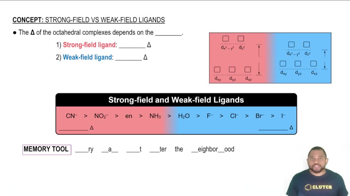
Ligand field strength refers to the ability of a ligand to influence the splitting of d-orbitals in a metal complex. Strong field ligands cause a larger splitting of the d-orbitals, leading to different electronic configurations and properties compared to weak field ligands, which result in smaller splitting.
Video consigliato:
Percorso guidato
02:40
Strong-Field Ligands result in a large Δ and Weak-Field Ligands result in a small Δ.

Geometry of Coordination Complexes

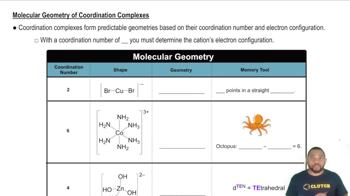
The geometry of coordination complexes, such as linear, tetrahedral, or octahedral, determines the spatial arrangement of ligands around the metal center. In a linear ML2 complex, the ligands are positioned 180 degrees apart, which affects the d-orbital splitting pattern and the overall electronic structure of the complex.
Video consigliato:
Percorso guidato
02:40
Molecular Geometry of Coordination Complexes