Predict the crystal field energy-level diagram for a linear ML2 complex that has two ligands along the :
Ch.21 - Transition Elements and Coordination Chemistry
Tutti i libri di testo
McMurry 8th Edition
Ch.21 - Transition Elements and Coordination Chemistry
Problema 21.30
McMurry 8th Edition
Ch.21 - Transition Elements and Coordination Chemistry
Problema 21.30Capitolo 21, Problema 21.30
Classify the following ligands as monodentate, bidentate, tri-dentate, or tetradentate. Which can form chelate rings?
(a)
(b)
(c)
(d)
Guida verificata passo dopo passo1
1. To classify ligands, we need to know their structures and how many sites they can use to bind to a central metal ion. Monodentate ligands have one site, bidentate ligands have two, tridentate ligands have three, and tetradentate ligands have four.
2. A ligand can form a chelate ring if it is at least bidentate, meaning it has two or more sites to bind to the central metal ion. This allows it to 'wrap around' the metal ion and form a ring structure.
3. Unfortunately, without the specific ligands provided in the problem, we cannot classify them or determine if they can form chelate rings. Please provide the specific ligands for further assistance.
4. Once the ligands are provided, you can identify the number of potential binding sites by looking for atoms with lone pairs of electrons. These are typically oxygen, nitrogen, or sulfur atoms in the ligand.
5. To determine if a ligand can form a chelate ring, look for multiple binding sites that are close enough together on the ligand to both bind to the same metal ion. If this is possible, the ligand can form a chelate ring.

Risposta video verificata per un problema simile:
Questa soluzione video è stata consigliata dai nostri tutor come utile per risolvere questo problema.
Concetti chiave
Ecco i concetti essenziali che devi comprendere per rispondere correttamente alla domanda.
Ligand Denticity
Denticity refers to the number of donor atoms in a ligand that can bind to a central metal atom in a coordination complex. Monodentate ligands have one donor atom, bidentate ligands have two, tridentate have three, and tetradentate have four. Understanding denticity is crucial for classifying ligands and predicting their behavior in coordination chemistry.
Video consigliato:
Percorso guidato
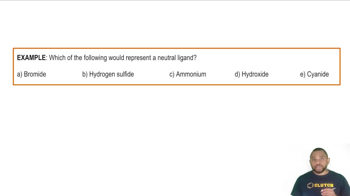
Ligands Example
Chelation
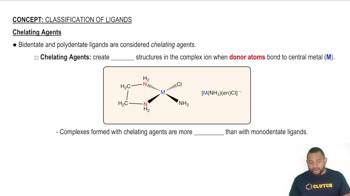
Chelation is the process by which a multidentate ligand binds to a metal ion, forming a stable ring structure known as a chelate. This occurs when the ligand wraps around the metal ion, creating a more stable complex than with monodentate ligands. Recognizing which ligands can form chelate rings is essential for understanding their stability and reactivity in various chemical environments.
Video consigliato:
Percorso guidato
Chelating Agents
Coordination Complexes
Coordination complexes consist of a central metal atom bonded to surrounding ligands. The nature of these ligands, including their denticity, influences the geometry, stability, and reactivity of the complex. Familiarity with coordination chemistry is necessary to classify ligands and predict the formation of chelate rings in these complexes.
Video consigliato:
Percorso guidato
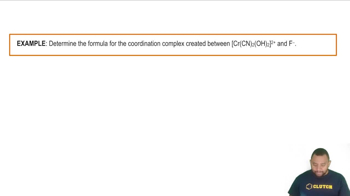
Coordination Complexes Example
Pratica correlata
Domanda del libro di testo
108
views
Domanda del libro di testo
What is the name of the compound [Fe(H2O)5(SCN)]Cl2?
(a) pentaaquathiocyanatoiron(III) chloride
(b) pentaaquachlorothiocyanato iron(III)
(c) pentaaquathiocyanatoiron(III) dichloride
(d) pentaaquathiocyanatoiron(II) chloride
494
views
Domanda del libro di testo
Assign a systematic name to each of the following ions.
(a) [AuCl4]-
(b) [Fe(CN)6]4-
187
views
Domanda del libro di testo
Predict the number of unpaired electrons for each of the following.
(a) Sc3+
(b) Co2+
83
views
Domanda del libro di testo
Draw the structure of all isomers of the octahedral complex [NbX2Cl4]- (X- = NCS-), and identify those that are linkage isomers.
99
views
Domanda del libro di testo
Which of the following complexes are diamagnetic?
(a) [Ni(H2O)6]2+
(b) [Co(CN)6]3-
(c) [HgI4]2- (tetrahedral)
(d) [Cu(NH3)4]2+ (square planar)
122
views