Ch.21 - Transition Elements and Coordination Chemistry
McMurry - Chemistry 8th Edition
McMurry8th EditionChemistryISBN: 9781292336145Non è quello che usi tu?Cambia libro di testo
Capitolo 21, Problema 21.129a

Two first-series transition metals have three unpaired electrons in complex ions of the type [MCl4]2-.
(a) What are the oxidation state and the identity of M in these complexes?
(b) Draw valence bond orbital diagrams for the two possible ions.
(c) Based on common oxidation states of first-series transition metals (Figure 21.6), which ion is more likely to exist?
<QUESTION REFERENCES FIGURE 21.6>

Guida verificata passo dopo passo
1
Determine the oxidation state of M: The complex ion is [MCl_4]^{2-}. Each chloride ion (Cl^-) has a charge of -1. Therefore, the total charge contributed by the four chloride ions is -4. Since the overall charge of the complex is -2, the oxidation state of M must be +2 to balance the charges.
Identify the transition metals with three unpaired electrons in a +2 oxidation state: In the first transition series, the metals with three unpaired electrons in a +2 oxidation state are typically those with a d^7 electron configuration. These metals are Cobalt (Co) and Nickel (Ni).
Draw valence bond orbital diagrams: For each metal ion, draw the d-orbital splitting diagram in a tetrahedral field. Show the distribution of electrons in the d-orbitals, ensuring that there are three unpaired electrons.
Consider the common oxidation states: Refer to Figure 21.6 or a similar resource to determine which of the two metals, Co or Ni, is more commonly found in the +2 oxidation state.
Conclude which ion is more likely to exist: Based on the common oxidation states and the stability of the electron configuration, determine which of the two ions, [CoCl_4]^{2-} or [NiCl_4]^{2-}, is more likely to exist.

Risposta video verificata per un problema simile:

Questa soluzione video è stata consigliata dai nostri tutor come utile per risolvere questo problema.

Concetti chiave

Ecco i concetti essenziali che devi comprendere per rispondere correttamente alla domanda.

Oxidation States of Transition Metals

The oxidation state of a transition metal in a complex ion indicates the charge of the metal ion after accounting for the charges of the ligands. In the case of [MCl4]2-, the overall charge is -2, and since each chloride ion (Cl-) has a charge of -1, the oxidation state of M can be calculated by balancing these charges. Understanding oxidation states is crucial for identifying the metal and its possible electronic configurations.
Video consigliato:
Percorso guidato
03:12
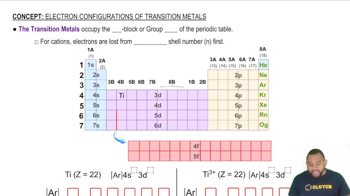
Transition Metals

Valence Bond Theory and Orbital Diagrams

Valence Bond Theory explains how atomic orbitals combine to form bonds in molecules. For transition metals, the d orbitals play a significant role in bonding and can be involved in hybridization. Drawing orbital diagrams for the complex ions helps visualize the arrangement of electrons, particularly the unpaired electrons, which are essential for determining the magnetic properties and reactivity of the complexes.
Video consigliato:
Percorso guidato
04:12
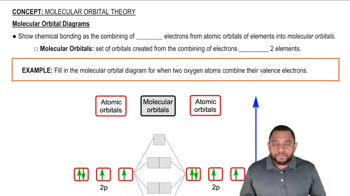
Molecular Orbital Diagram

Common Oxidation States of First-Series Transition Metals

First-series transition metals exhibit a variety of oxidation states due to the involvement of d electrons in bonding. Common oxidation states can be predicted based on the electron configuration and the stability of the resulting ions. By referring to Figure 21.6, one can assess which oxidation states are more prevalent and likely to form stable complexes, aiding in the identification of the metal in the given complex.
Video consigliato:
Percorso guidato
03:12
Transition Metals
Pratica correlata
Domanda del libro di testo

What is the systematic name for each of the following coordination compounds? 

(a) Cs[FeCl4]

(b) [V(H2O)6](NO3)3

162
views

Domanda del libro di testo

Assign a systematic name to each of the following ions.  

(a) [AuCl4]-

(b) [Fe(CN)6]4-

187
views
Domanda del libro di testo

Constitutional isomers of a ruthenium(II) coordination compound are shown below.

(a) Give the formula and name for structures 1-3.

(b) Which structures are linkage isomers? 

(c) Which structures are ionization isomers?

93
views
Domanda del libro di testo

Tell how many diastereoisomers are possible for each of the following complexes, and draw their structures. 

(a) Pt(NH3)3Cl (square planar) 

(b) [FeBr2Cl2(en)]-

103
views
Domanda del libro di testo

Nickel(II) complexes with the formula NiX2L2, where X− is Cl− or N-bonded NCS− and L is the monodentate triphenylphosphine ligand P(C6H5)3, can be square planar or tetrahedral.

(a) Draw crystal field energy-level diagrams for a square planar and a tetrahedral nickel(II) complex, and show the population of the orbitals.

98
views
Domanda del libro di testo

There are two possible [M(OH)4]- complexes of first-series transition metals that have three unpaired electrons.

(a) What are the oxidation state and the identity of M in these complexes?

(b) Using orbital diagrams, give a valence bond description of the bonding in each complex.

(c) Based on common oxidation states of first-series transition metals (Figure 21.6), which [M(OH)4]- complex is more likely to exist? 

<QUESTION REFERENCES FIGURE 21.6>-

106
views