In octahedral complexes, the choice between high-spin and low-spin electron configurations arises only for d4 - d7 complexes. Explain.
Ch.21 - Transition Elements and Coordination Chemistry
Tutti i libri di testo
McMurry 8th Edition
Ch.21 - Transition Elements and Coordination Chemistry
Problema 99
McMurry 8th Edition
Ch.21 - Transition Elements and Coordination Chemistry
Problema 99Capitolo 21, Problema 99
The reaction of the octahedral complex Co(NH3)3(NO2)3 with HCl yields a complex [Co(NH3)3(H2O)Cl2]+ in which the two chloride ligands are trans to one another.
(a) Draw the two possible stereoisomers of the starting material [Co(NH3)3(NO2)3]. (All three NO2- ligands are bonded to Co through the N atom.)
(b) Assuming that the NH3 groups remain in place, which of the two starting isomers could give rise to the observed product?
Guida verificata passo dopo passo1
Identify the coordination geometry of the complex [Co(NH3)3(NO2)3]. Since it is octahedral, the ligands are arranged around the central cobalt ion in an octahedral fashion.
Draw the two possible stereoisomers of the complex. In an octahedral complex with three identical ligands, the isomers can be facial (fac) or meridional (mer).
For the fac isomer, place the three NO2- ligands adjacent to each other, forming a face of the octahedron. The remaining three NH3 ligands will occupy the other three positions.
For the mer isomer, arrange the three NO2- ligands such that they form a meridian, with two NO2- ligands opposite each other and the third one adjacent to one of them. The NH3 ligands will fill the remaining positions.
To determine which isomer could give rise to the observed product [Co(NH3)3(H2O)Cl2]+ with trans Cl- ligands, consider the positions of the NO2- ligands that can be replaced by Cl- and H2O. The mer isomer allows for two trans positions to be replaced, leading to the observed product.

Risposta video verificata per un problema simile:
Questa soluzione video è stata consigliata dai nostri tutor come utile per risolvere questo problema.
Concetti chiave
Ecco i concetti essenziali che devi comprendere per rispondere correttamente alla domanda.
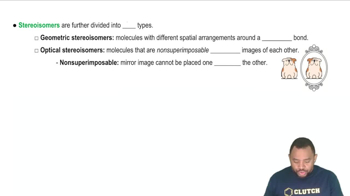
Stereoisomerism
Stereoisomerism refers to the phenomenon where compounds have the same molecular formula and connectivity of atoms but differ in the spatial arrangement of those atoms. In coordination chemistry, this can lead to different geometric isomers, such as cis and trans configurations, which can significantly affect the properties and reactivity of the complexes.
Video consigliato:
Percorso guidato
Stereoisomers
Octahedral Complexes
Octahedral complexes are coordination compounds where a central metal atom is surrounded by six ligands arranged at the corners of an octahedron. The geometry of these complexes can lead to various isomeric forms, depending on the nature and arrangement of the ligands, which is crucial for understanding the reactivity and product formation in reactions involving these complexes.
Video consigliato:
Percorso guidato
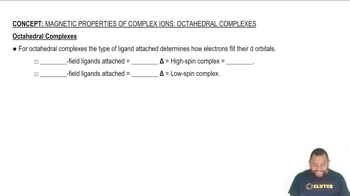
For octahedral complexes, Weak-Field Ligands create High-spin complexes and Strong-Field Ligands create Low-spin complexes.
Ligand Substitution Reactions
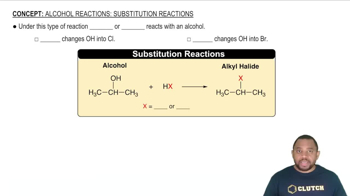
Ligand substitution reactions involve the replacement of one ligand in a coordination complex with another ligand. The outcome of these reactions can depend on the geometry of the starting complex and the nature of the incoming ligand, which is essential for predicting the products formed, such as the observed complex [Co(NH3)3(H2O)Cl2]+ in this case.
Video consigliato:
Percorso guidato
Alcohol Reactions: Substitution Reactions
Pratica correlata
Domanda del libro di testo
112
views
Domanda del libro di testo
Consider the octahedral complex [Co(en)(dien)Cl]2+, where dien = H2NCH2CH2NHCH2CH2NH2, which can be abbreivated
(a) The dien (diethylenetriamine) ligand is a tridentate ligand. Explain what is meant by 'tridentate' and why dien can act as a tridentate ligand.
(b) Draw all possible stereoisomers of [Co(en)(dien)Cl]2+ (dien is a flexible ligand). Which stereoisomers are chiral, and which are achiral?
117
views
Domanda del libro di testo
Tris(2-aminoethyl)amine, abbreviated tren, is the tetradentate ligand N(CH2CH2NH2)3. Using to represent each of the three NCH2CH2NH2 segments of the ligand, sketch all possible isomers of the octahedral complex [Co(tren)BrCl]+.
86
views