Ch.21 - Transition Elements and Coordination Chemistry
McMurry - Chemistry 8th Edition
McMurry8th EditionChemistryISBN: 9781292336145Non è quello che usi tu?Cambia libro di testo
Capitolo 21, Problema 103

Use a sketch to explain why the dxy and dx2-y2 orbitals have different energies in an octahedral complex. Which of the two orbitals has higher energy?

Guida verificata passo dopo passo
1
Step 1: Understand the geometry of an octahedral complex. In an octahedral complex, a central metal atom is surrounded by six ligands positioned at the corners of an octahedron. This arrangement leads to specific interactions between the metal's d orbitals and the ligands.
Step 2: Recall the five d orbitals: d_{xy}, d_{yz}, d_{zx}, d_{x^2-y^2}, and d_{z^2}. In a free atom, these orbitals are degenerate, meaning they have the same energy. However, in an octahedral complex, the presence of ligands causes a splitting of these energy levels.
Step 3: Consider the orientation of the d orbitals. The d_{xy} orbital lies in the xy-plane, while the d_{x^2-y^2} orbital also lies in the xy-plane but has lobes along the x and y axes. In an octahedral complex, ligands approach along the x, y, and z axes.
Step 4: Analyze the interaction with ligands. The d_{x^2-y^2} orbital has lobes that point directly towards the ligands along the x and y axes, leading to greater repulsion and higher energy. In contrast, the d_{xy} orbital's lobes are oriented between the axes, resulting in less direct interaction with the ligands and lower energy.
Step 5: Conclude which orbital has higher energy. Due to the direct interaction with the ligands, the d_{x^2-y^2} orbital experiences greater repulsion and thus has higher energy compared to the d_{xy} orbital in an octahedral complex.

Concetti chiave

Ecco i concetti essenziali che devi comprendere per rispondere correttamente alla domanda.

Crystal Field Theory

Crystal Field Theory (CFT) explains how the arrangement of ligands around a central metal ion affects the energy levels of its d-orbitals. In an octahedral complex, the ligands approach the metal ion along the axes, leading to a splitting of the d-orbitals into two energy levels: the lower-energy t2g set and the higher-energy eg set. This theory helps in understanding the electronic structure and stability of coordination complexes.
Video consigliato:
Percorso guidato
01:18
The study of ligand-metal interactions helped to form Ligand Field Theory which combines CFT with MO Theory.

d-Orbital Splitting in Octahedral Fields

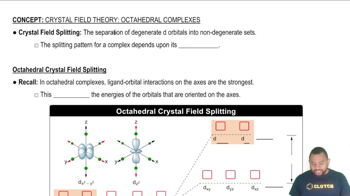
In an octahedral field, the five d-orbitals split into two groups due to the electrostatic interactions with surrounding ligands. The dxy and dx2-y2 orbitals are part of the eg set, which is higher in energy compared to the t2g set. The dx2-y2 orbital, oriented along the axes, experiences greater repulsion from the ligands than the dxy orbital, which is oriented between the axes, resulting in different energy levels.
Video consigliato:
Percorso guidato
03:04
The crystal field splitting pattern for octahedral complexes has the d orbitals on or along the axes as having the higher energy.

Ligand Field Strength

Ligand field strength refers to the ability of ligands to influence the energy levels of d-orbitals in a metal complex. Strong field ligands cause greater splitting of the d-orbitals, while weak field ligands result in smaller splitting. In the context of the dxy and dx2-y2 orbitals, the ligand field strength determines the extent of energy difference between these orbitals, with the dx2-y2 typically having higher energy due to its direct alignment with the ligands.
Video consigliato:
Percorso guidato
02:40
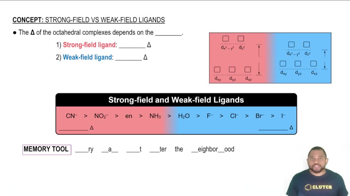
Strong-Field Ligands result in a large Δ and Weak-Field Ligands result in a small Δ.