Ch.21 - Transition Elements and Coordination Chemistry
McMurry - Chemistry 8th Edition
McMurry8th EditionChemistryISBN: 9781292336145Non è quello che usi tu?Cambia libro di testo
Capitolo 21, Problema 62d

What is the coordination number of the metal in each of the following complexes?
(d) [ZrF8]4-
(e) [Fe(EDTA)(H2O)]-

Guida verificata passo dopo passo
1
1. The coordination number of a metal in a complex is the number of ligand electron pairs surrounding that metal ion. In other words, it's the number of atoms directly bonded to the metal ion.
2. For the complex [ZrF8]4-, the ligand is F- (fluoride ion). Each fluoride ion can form one bond with the metal ion. Since there are 8 fluoride ions in the complex, the coordination number of Zr is 8.
3. For the complex [Fe(EDTA)(H2O)]-, the ligands are EDTA and H2O. EDTA is a hexadentate ligand, meaning it can form 6 bonds with the metal ion. H2O is a monodentate ligand, meaning it can form one bond with the metal ion. Therefore, the coordination number of Fe in this complex is 6 (from EDTA) + 1 (from H2O) = 7.

Risposta video verificata per un problema simile:

Questa soluzione video è stata consigliata dai nostri tutor come utile per risolvere questo problema.

Concetti chiave

Ecco i concetti essenziali che devi comprendere per rispondere correttamente alla domanda.

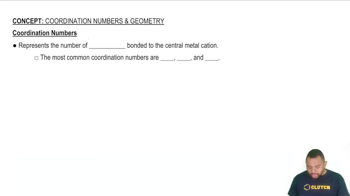
Coordination Number

The coordination number refers to the number of ligand atoms that are directly bonded to a central metal atom in a coordination complex. It is a crucial concept in coordination chemistry, as it helps determine the geometry and stability of the complex. For example, a coordination number of 6 typically leads to an octahedral geometry, while a coordination number of 4 can lead to either tetrahedral or square planar geometries.
Video consigliato:
Percorso guidato
00:27
Coordination Numbers

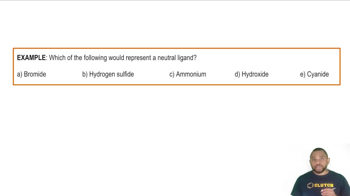
Ligands

Ligands are ions or molecules that can donate a pair of electrons to a central metal atom to form a coordination complex. They can be classified as monodentate, bidentate, or polydentate based on the number of donor atoms they possess. In the given complexes, fluoride ions (F-) and the EDTA ligand are examples of ligands that coordinate with the metal center, influencing the overall structure and properties of the complex.
Video consigliato:
Percorso guidato
01:12
Ligands Example

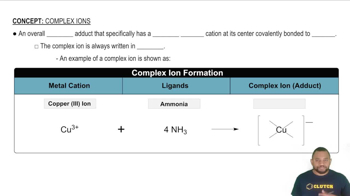
Complex Ions

Complex ions are charged species consisting of a central metal atom bonded to one or more ligands. They can carry a positive or negative charge depending on the nature of the metal and the ligands involved. Understanding complex ions is essential for determining the coordination number, as it directly relates to how many ligands surround the metal center, as seen in the complexes [ZrF8]4- and [Fe(EDTA)(H2O)]-.
Video consigliato:
Percorso guidato
02:09
Complex Ion Formation