
Ch.21 - Transition Elements and Coordination Chemistry
McMurry - Chemistry 8th Edition
McMurry8th EditionChemistryISBN: 9781292336145Non è quello che usi tu?Cambia libro di testo
Capitolo 21, Problema 66

Identify the oxidation state of the metal in each of the following compounds.
(a) Co(NH3)3(NO2)3
(b) [Ag(NH3)2]NO3
(c) K3[Cr(C2O4)2Cl2]
(d) Cs[CuCl2]

Guida verificata passo dopo passo
1
Step 1: Understand that the oxidation state of a compound must sum up to the overall charge of the compound. For neutral compounds, the sum is zero, while for ions, it equals the ion charge.
Step 2: For Co(NH3)3(NO2)3, recognize that NH3 is a neutral ligand and NO2 is a -1 ligand. Set up an equation with the unknown oxidation state of Co and solve for it considering the compound is neutral.
Step 3: For [Ag(NH3)2]NO3, note that NH3 is neutral and NO3 is -1. Since the complex ion [Ag(NH3)2]+ must balance the -1 charge of NO3, determine the oxidation state of Ag in the complex ion.
Step 4: In K3[Cr(C2O4)2Cl2], recognize that K has a +1 charge, C2O4 (oxalate) is a -2 ligand, and Cl is a -1 ligand. Set up an equation for the oxidation state of Cr in the complex ion [Cr(C2O4)2Cl2]3- and solve it.
Step 5: For Cs[CuCl2], identify that Cs has a +1 charge and Cl has a -1 charge. Since the complex ion [CuCl2]- must balance the +1 charge of Cs, determine the oxidation state of Cu in the complex ion.

Risposta video verificata per un problema simile:

Questa soluzione video è stata consigliata dai nostri tutor come utile per risolvere questo problema.

Concetti chiave

Ecco i concetti essenziali che devi comprendere per rispondere correttamente alla domanda.

Oxidation State

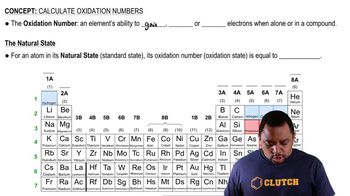
The oxidation state, or oxidation number, is a value that represents the total number of electrons an atom either gains or loses when it forms a compound. It helps in understanding the electron transfer in redox reactions and is crucial for determining the reactivity and stability of compounds. Oxidation states are assigned based on a set of rules, including the fact that the sum of oxidation states in a neutral compound must equal zero.
Video consigliato:
Percorso guidato
02:42
Oxidation Numbers

Coordination Compounds

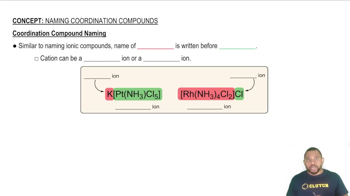
Coordination compounds consist of a central metal atom bonded to surrounding molecules or ions, known as ligands. The nature of these ligands can influence the oxidation state of the metal, as they can donate electron pairs to the metal. Understanding the structure and bonding in coordination compounds is essential for determining the oxidation states of the metal ions present.
Video consigliato:
Percorso guidato
01:32
Coordination Compound Naming

Common Ligands and Their Charges

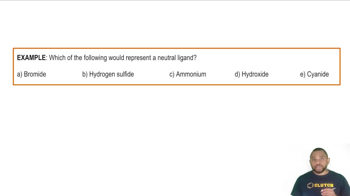
Common ligands, such as ammonia (NH3) and nitrite (NO2), have specific charges that contribute to the overall charge of the coordination complex. For example, NH3 is a neutral ligand, while NO2 typically has a -1 charge. Knowing the charges of ligands is vital for calculating the oxidation state of the central metal atom by balancing the total charge of the complex with the oxidation states of the ligands.
Video consigliato:
Percorso guidato
01:12
Ligands Example