Ch.22 - The Main Group Elements
McMurry - Chemistry 8th Edition
McMurry8th EditionChemistryISBN: 9781292336145Non è quello che usi tu?Cambia libro di testo
Capitolo 22, Problema 138b

Account for each of the following observations.
b. SF4 exists, but OF4 does not.

Guida verificata passo dopo passo
1
insert step 1> Consider the electronic configuration of sulfur (S) and oxygen (O). Sulfur has the electronic configuration [Ne] 3s^2 3p^4, while oxygen has [He] 2s^2 2p^4.
insert step 2> Analyze the ability of sulfur and oxygen to expand their octet. Sulfur, being in the third period, can utilize d-orbitals to expand its octet, allowing it to form more than four bonds.
insert step 3> Consider the valence shell electron pair repulsion (VSEPR) theory. SF_4 has a seesaw shape due to the presence of one lone pair and four bonding pairs around sulfur.
insert step 4> Evaluate the electronegativity and size of the central atom. Oxygen is more electronegative and smaller than sulfur, which limits its ability to form multiple bonds with fluorine atoms.
insert step 5> Conclude that the inability of oxygen to expand its octet and its high electronegativity prevent the formation of OF_4, whereas sulfur can form SF_4 due to its ability to expand its octet and accommodate more bonds.

Risposta video verificata per un problema simile:

Questa soluzione video è stata consigliata dai nostri tutor come utile per risolvere questo problema.

Concetti chiave

Ecco i concetti essenziali che devi comprendere per rispondere correttamente alla domanda.

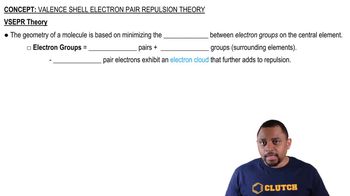
Valence Shell Electron Pair Repulsion (VSEPR) Theory

VSEPR theory is used to predict the geometry of molecular structures based on the repulsion between electron pairs around a central atom. In the case of SF4, the sulfur atom has six valence electrons, allowing it to form four bonds with fluorine and maintain a stable structure with a seesaw shape. Conversely, OF4 would require oxygen to accommodate four bonds, which is not feasible due to its limited valence electrons.
Video consigliato:
Percorso guidato
00:47
Valence Shell Electron Pair Repulsion Theory

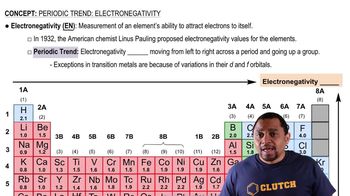
Electronegativity and Bonding

Electronegativity refers to the tendency of an atom to attract electrons in a bond. Sulfur is less electronegative than fluorine, allowing SF4 to form stable covalent bonds. In contrast, oxygen is more electronegative than sulfur, leading to instability in OF4 as the oxygen atom would struggle to form four stable bonds without exceeding its octet.
Video consigliato:
Percorso guidato
02:10
Electronegativity Trends

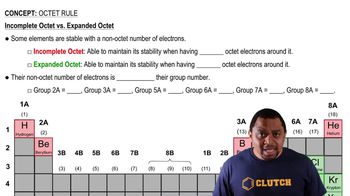
Molecular Stability and Octet Rule

The octet rule states that atoms tend to form bonds in such a way that they have eight electrons in their valence shell, achieving a stable electron configuration. SF4 adheres to this rule, while OF4 does not, as oxygen can only accommodate a maximum of two additional electrons in its valence shell, making the formation of OF4 energetically unfavorable and unstable.
Video consigliato: