Ch.22 - The Main Group Elements
McMurry - Chemistry 8th Edition
McMurry8th EditionChemistryISBN: 9781292336145Non è quello che usi tu?Cambia libro di testo
Capitolo 22, Problema 139

Account for each of the following observations: (a) Oxygen is more electronegative than sulfur. (b) Sulfur forms long Sn chains, but oxygen does not.

Guida verificata passo dopo passo
1
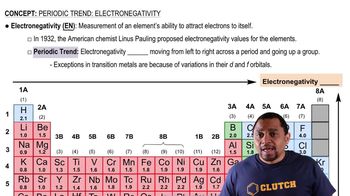
Step 1: Discuss the concept of electronegativity, which is the ability of an atom to attract electrons in a chemical bond. Explain that electronegativity generally increases across a period and decreases down a group in the periodic table.
Step 2: Explain that oxygen is located above sulfur in Group 16 of the periodic table. Due to its position, oxygen has a higher electronegativity than sulfur because it is smaller in size and has a greater effective nuclear charge, which allows it to attract electrons more strongly.
Step 3: Introduce the concept of allotropy, which is the existence of an element in more than one form or structure. Discuss how sulfur can form various allotropes, including long chains of sulfur atoms (Sn), due to its ability to catenate, or form bonds with itself.
Step 4: Explain that oxygen, being a smaller atom with a higher electronegativity, tends to form strong double bonds (O=O) rather than long chains. This is because the formation of double bonds is more energetically favorable for oxygen compared to forming long chains.
Step 5: Conclude by summarizing that the differences in electronegativity and atomic size between oxygen and sulfur account for the observed differences in their chemical behavior, such as oxygen's higher electronegativity and sulfur's ability to form long chains.

Concetti chiave

Ecco i concetti essenziali che devi comprendere per rispondere correttamente alla domanda.

Electronegativity

Electronegativity is a measure of an atom's ability to attract and hold onto electrons in a chemical bond. It is influenced by factors such as atomic size and the effective nuclear charge. In the case of oxygen and sulfur, oxygen has a higher electronegativity due to its smaller atomic radius and greater effective nuclear charge, making it more capable of attracting electrons.
Video consigliato:
Percorso guidato
02:10
Electronegativity Trends

Atomic Structure and Bonding

The atomic structure of an element, including its electron configuration, plays a crucial role in determining its bonding behavior. Sulfur, with its larger atomic size and ability to form multiple bonds, can create long chains (like polysulfides) through covalent bonding. In contrast, oxygen's smaller size and high electronegativity lead to stronger, more localized bonds, preventing it from forming similar long chains.
Video consigliato:

Molecular Geometry and Hybridization

Molecular geometry and hybridization describe how atomic orbitals combine to form molecular orbitals, influencing the shape and connectivity of molecules. Sulfur can utilize d-orbitals in addition to s and p orbitals, allowing for various hybridization states that facilitate the formation of extended structures. Oxygen, however, typically forms sp3 or sp2 hybridized structures, which are more suited for discrete molecules rather than long chains.
Video consigliato:
Percorso guidato
03:06
Hybridization and Electron Geometry