Ch.22 - The Main Group Elements
McMurry - Chemistry 8th Edition
McMurry8th EditionChemistryISBN: 9781292336145Non è quello che usi tu?Cambia libro di testo
Capitolo 22, Problema 22.29b

Consider the six second- and third-row elements in groups 4A–6A of the periodic table:


Possible structures for the binary fluorides of each of these elements in its highest oxidation state are shown below.


(b) Explain why the fluorides of nitrogen and phosphorus have different molecular structures but the fluorides of carbon and silicon have the same molecular structure.

Guida verificata passo dopo passo
1
Step 1: Identify the elements in groups 4A–6A of the periodic table. These include carbon (C), silicon (Si), nitrogen (N), and phosphorus (P).
Step 2: Understand the highest oxidation states for these elements when they form binary fluorides. For nitrogen and phosphorus, the highest oxidation states are +5, forming NF5 and PF5. For carbon and silicon, the highest oxidation states are +4, forming CF4 and SiF4.
Step 3: Consider the molecular geometry of these compounds. NF5 does not exist due to nitrogen's inability to expand its octet, while PF5 has a trigonal bipyramidal structure. CF4 and SiF4 both have a tetrahedral structure.
Step 4: Explain the difference in molecular structures for nitrogen and phosphorus fluorides. Nitrogen, being in the second period, cannot expand its octet, limiting it to forming NF3 with a trigonal pyramidal shape. Phosphorus, in the third period, can expand its octet, allowing PF5 to form with a trigonal bipyramidal shape.
Step 5: Explain the similarity in molecular structures for carbon and silicon fluorides. Both carbon and silicon form tetrahedral structures (CF4 and SiF4) because they both achieve a stable configuration by sharing four pairs of electrons with fluorine atoms, and neither can expand their octet.

Risposta video verificata per un problema simile:

Questa soluzione video è stata consigliata dai nostri tutor come utile per risolvere questo problema.

Concetti chiave

Ecco i concetti essenziali che devi comprendere per rispondere correttamente alla domanda.

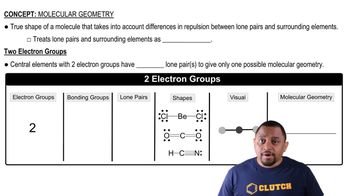
Molecular Geometry

Molecular geometry refers to the three-dimensional arrangement of atoms within a molecule. It is determined by the number of bonding pairs and lone pairs of electrons around the central atom, which influences the shape of the molecule. For example, carbon and silicon both have tetrahedral geometries in their fluorides due to their similar bonding characteristics and the presence of four equivalent bonds.
Video consigliato:
Percorso guidato
01:33
Molecular Geometry with Two Electron Groups

Hybridization

Hybridization is the concept of mixing atomic orbitals to form new hybrid orbitals that can accommodate bonding. The type of hybridization affects the molecular structure; for instance, nitrogen undergoes sp3 hybridization in NF3, leading to a trigonal pyramidal shape, while phosphorus can exhibit sp3d hybridization in PF5, resulting in a trigonal bipyramidal structure. This difference in hybridization explains the distinct molecular geometries of nitrogen and phosphorus fluorides.
Video consigliato:

Oxidation States and Bonding

The oxidation state of an element in a compound indicates the degree of oxidation or reduction it has undergone. In the case of binary fluorides, the highest oxidation states of carbon and silicon lead to similar bonding characteristics, resulting in analogous molecular structures. Conversely, nitrogen and phosphorus, despite being in the same group, can exhibit different oxidation states and bonding behaviors, leading to variations in their molecular structures.
Video consigliato:
Percorso guidato
02:42
Oxidation Numbers