
Ch.22 - The Main Group Elements
McMurry - Chemistry 8th Edition
McMurry8th EditionChemistryISBN: 9781292336145Non è quello che usi tu?Cambia libro di testo
Capitolo 22, Problema 22.39a

Which element in each of the following pairs has more nonmetallic character?
(a) Se or Te

Guida verificata passo dopo passo
1
Identify the position of Se (Selenium) and Te (Tellurium) on the periodic table.
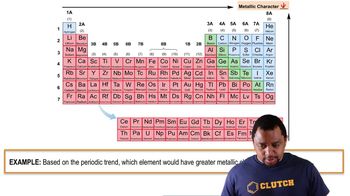
Recall that nonmetallic character increases as you move from left to right across a period and decreases as you move down a group.
Note that both Se and Te are in the same group (Group 16) of the periodic table.
Since Se is above Te in the same group, it is higher up on the periodic table.
Conclude that Se has more nonmetallic character than Te because nonmetallic character decreases down a group.

Risposta video verificata per un problema simile:

Questa soluzione video è stata consigliata dai nostri tutor come utile per risolvere questo problema.

Concetti chiave

Ecco i concetti essenziali che devi comprendere per rispondere correttamente alla domanda.

Nonmetallic Character

Nonmetallic character refers to the tendency of an element to exhibit properties typical of nonmetals, such as high electronegativity, poor conductivity, and the ability to gain electrons. Nonmetals are generally found on the right side of the periodic table and are characterized by their ability to form covalent bonds and anions.
Video consigliato:
Percorso guidato
00:56
Metallic Character Example

Periodic Trends

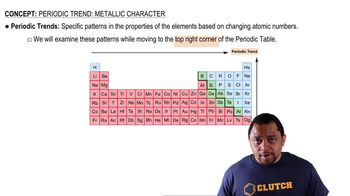
Periodic trends are patterns observed in the properties of elements across the periodic table. Nonmetallic character increases as you move from left to right across a period and decreases as you move down a group. Understanding these trends helps predict the behavior of elements based on their position in the periodic table.
Video consigliato:
Percorso guidato
00:38
Periodic Trends

Group and Period Positioning

Elements are organized in groups (columns) and periods (rows) in the periodic table. Selenium (Se) and tellurium (Te) are both in Group 16, but Se is higher in the group than Te. The position of an element in the periodic table influences its properties, including its nonmetallic character, which typically decreases down a group.
Video consigliato:
Percorso guidato
01:33
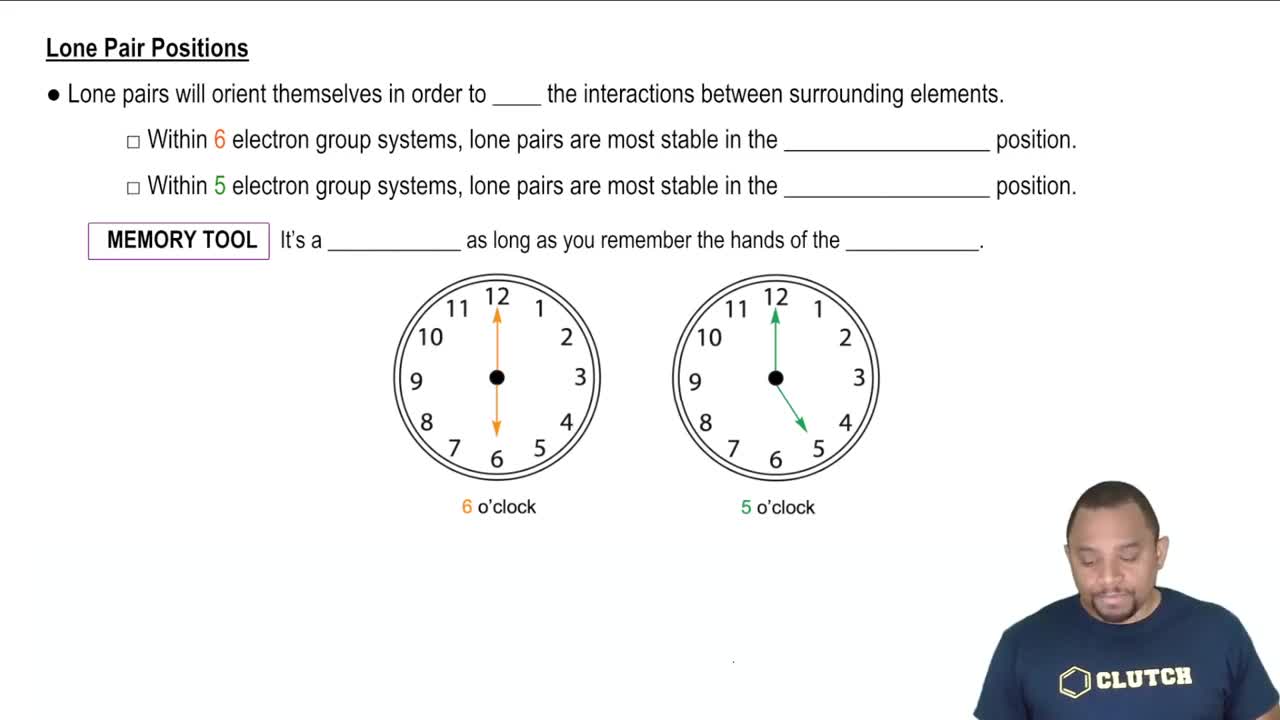
Lone Pair Positions
Pratica correlata
Domanda del libro di testo

An important physiological reaction of nitric oxide (NO) is its interaction with the superoxide ion (O2–) to form the peroxynitrite ion (ONOO–).

a. Write electron-dot structures for NO, O2–, and ONOO–, and predict the O–N–O bond angle in ONOO–.

102
views
Domanda del libro di testo

Write a balanced net ionic equation for the reaction of the amphoteric oxide Ga2O3 with:

a. Aqueous sulfuric acid

73
views
Domanda del libro di testo

The following pictures represent various silicate anions. Write the formula and charge of each anion.

97
views
Domanda del libro di testo

In the following pictures of binary hydrides, ivory spheres

represent H atoms or ions, and burgundy spheres represent

atoms or ions of the other element.

(1)

(2)

(3)

(4)

(a) Identify each binary hydride as ionic, covalent, or interstitial.

(b) What is the oxidation state of hydrogen in compounds (1), (2), and (3)? What is the oxidation state of the other

element?

91
views
Domanda del libro di testo

Consider the six second- and third-row elements in groups 4A–6A of the periodic table:


Possible structures for the binary fluorides of each of these elements in its highest oxidation state are shown below.


(b) Explain why the fluorides of nitrogen and phosphorus have different molecular structures but the fluorides of carbon and silicon have the same molecular structure.

118
views
Domanda del libro di testo

The following pictures represent structures of the hydrides of four second-row elements:

(1)

(2)

(3)

(4)

(a) Which compound has the highest melting point?

96
views