Ch.22 - The Main Group Elements
McMurry - Chemistry 8th Edition
McMurry8th EditionChemistryISBN: 9781292336145Non è quello che usi tu?Cambia libro di testo
Capitolo 22, Problema 58

In the following compound, is hydrogen present as H+, H-, or a covalently bound H atom? (b) PH3

Guida verificata passo dopo passo
1
Step 1: Identify the compound in question, which is phosphine (PH3).
Step 2: Consider the electronegativity of the elements involved. Phosphorus (P) is less electronegative than hydrogen (H).
Step 3: Determine the type of bonding in PH3. Since hydrogen is less electronegative than phosphorus, it is unlikely to exist as H+.
Step 4: Analyze the structure of PH3. Phosphine is a covalent compound where hydrogen atoms are covalently bonded to phosphorus.
Step 5: Conclude that in PH3, hydrogen is present as a covalently bound H atom, not as H+ or H-.

Concetti chiave

Ecco i concetti essenziali che devi comprendere per rispondere correttamente alla domanda.

Hydrogen Ion (H+)

H+ represents a hydrogen ion, which is a proton that has lost its electron. In aqueous solutions, H+ is often associated with acids, as they release protons into the solution. Understanding the behavior of H+ is crucial for analyzing acid-base reactions and the overall charge balance in compounds.
Video consigliato:
Percorso guidato
01:22
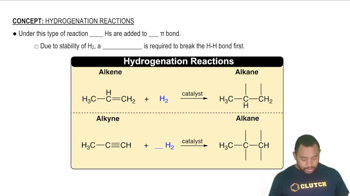
Hydrogenation Reactions

Hydride Ion (H-)

H- is a hydride ion, formed when hydrogen gains an electron, resulting in a negatively charged species. Hydrides are typically found in ionic compounds and can act as reducing agents. Recognizing the presence of H- is important for understanding the reactivity and bonding characteristics of certain compounds.
Video consigliato:

Covalently Bound Hydrogen

Covalently bound hydrogen refers to hydrogen atoms that are bonded to other atoms through shared electron pairs, forming covalent bonds. In molecular compounds, such as PH3, hydrogen typically forms these bonds with other nonmetals. Identifying covalent bonds is essential for predicting molecular geometry and chemical behavior.
Video consigliato:
Percorso guidato
01:05
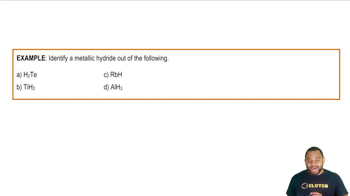
Hydrogen Compounds Example