Ch.22 - The Main Group Elements
McMurry - Chemistry 8th Edition
McMurry8th EditionChemistryISBN: 9781292336145Non è quello che usi tu?Cambia libro di testo
Capitolo 22, Problema 57

Write the chemical formula of a compound that contains hydrogen and each of the following elements. Which of these compounds are ionic, and which are covalent? (a) K (b) S

Guida verificata passo dopo passo
1
Step 1: Identify the type of element (metal or non-metal) for each given element. Potassium (K) is a metal, and sulfur (S) is a non-metal.
Step 2: Determine the type of bond formed with hydrogen. Metals typically form ionic bonds with hydrogen, while non-metals form covalent bonds.
Step 3: Write the chemical formula for the compound with potassium (K) and hydrogen. Since K is a metal, it forms an ionic compound with hydrogen, resulting in potassium hydride (KH).
Step 4: Write the chemical formula for the compound with sulfur (S) and hydrogen. Since S is a non-metal, it forms a covalent compound with hydrogen, resulting in hydrogen sulfide (H2S).
Step 5: Summarize the bonding types: KH is an ionic compound, and H2S is a covalent compound.

Concetti chiave

Ecco i concetti essenziali che devi comprendere per rispondere correttamente alla domanda.

Chemical Bonding

Chemical bonding refers to the forces that hold atoms together in a compound. There are two primary types of bonds: ionic and covalent. Ionic bonds form when electrons are transferred from one atom to another, typically between metals and nonmetals, resulting in charged ions. Covalent bonds, on the other hand, involve the sharing of electrons between atoms, usually between nonmetals.
Video consigliato:

Ionic Compounds

Ionic compounds are formed when metals react with nonmetals, resulting in the transfer of electrons and the formation of ions. These compounds typically have high melting and boiling points and are soluble in water. In the context of the question, potassium (K) would form an ionic compound with hydrogen and sulfur, as it is a metal that readily loses an electron to form a positive ion.
Video consigliato:
Percorso guidato
02:11
Ionic Compounds Naming

Covalent Compounds

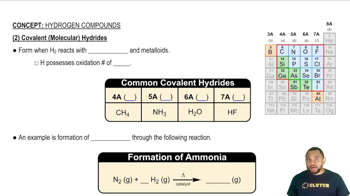
Covalent compounds are formed when two nonmetals share electrons to achieve a full outer shell. These compounds usually have lower melting and boiling points compared to ionic compounds and may not conduct electricity in solution. In the case of hydrogen and sulfur, they would form a covalent compound (H2S) as both are nonmetals that share electrons rather than transferring them.
Video consigliato:
Percorso guidato
02:04
Covalent (Molecular) Hydrides