Ch.22 - The Main Group Elements
McMurry - Chemistry 8th Edition
McMurry8th EditionChemistryISBN: 9781292336145Non è quello che usi tu?Cambia libro di testo
Capitolo 22, Problema 22.26e

Look at the location of elements A, B, C, and D in the following periodic table:
(e) Which of these oxides has the highest melting point? Which has the lowest melting point?

Guida verificata passo dopo passo
1
Identify the elements A, B, C, and D on the periodic table and determine their group and period.
Recall that oxides of metals typically have higher melting points than oxides of nonmetals.
Consider the metallic character of each element: elements on the left side of the periodic table are more metallic, while those on the right are more nonmetallic.
Determine the type of oxide each element forms: metal oxides are usually ionic and have high melting points, while nonmetal oxides are covalent and have lower melting points.
Compare the oxides based on their ionic or covalent nature to determine which has the highest and lowest melting points.

Risposta video verificata per un problema simile:

Questa soluzione video è stata consigliata dai nostri tutor come utile per risolvere questo problema.

Concetti chiave

Ecco i concetti essenziali che devi comprendere per rispondere correttamente alla domanda.

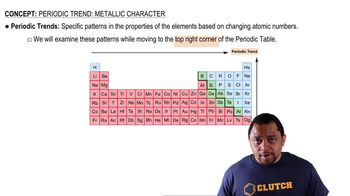
Periodic Trends

Periodic trends refer to the predictable patterns observed in the properties of elements as you move across or down the periodic table. Key trends include atomic radius, ionization energy, electronegativity, and melting point. Understanding these trends helps in predicting the behavior of elements and their compounds, including their oxides.
Video consigliato:
Percorso guidato
00:38
Periodic Trends

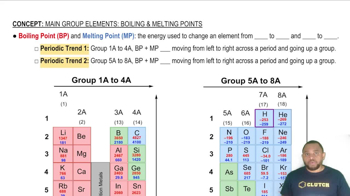
Melting Point of Oxides

The melting point of oxides is influenced by the type of bonding and the structure of the oxide. Ionic oxides, typically formed between metals and nonmetals, tend to have higher melting points due to strong ionic bonds. In contrast, covalent oxides, often formed between nonmetals, may have lower melting points due to weaker intermolecular forces.
Video consigliato:
Percorso guidato
04:29
Boiling Point and Melting Point

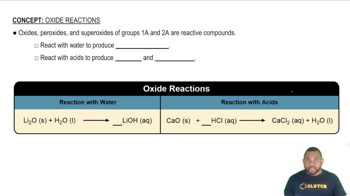
Metallic vs. Nonmetallic Oxides

Metallic oxides are generally basic and tend to have higher melting points, while nonmetallic oxides are often acidic and can have lower melting points. The position of elements in the periodic table indicates whether they are metals or nonmetals, which directly affects the properties of their oxides, including melting points.
Video consigliato:
Percorso guidato
00:58
Oxide Reactions