
Ch.22 - The Main Group Elements
McMurry - Chemistry 8th Edition
McMurry8th EditionChemistryISBN: 9781292336145Non è quello che usi tu?Cambia libro di testo
Capitolo 22, Problema 22.44e

Consider the elements C, Se, B, Sn, and Cl. Identify which of these elements:
e. Forms a hydride with the empirical formula 

Guida verificata passo dopo passo
1
Identify the group and period of each element: C (Carbon), Se (Selenium), B (Boron), Sn (Tin), and Cl (Chlorine).
Recall that hydrides are compounds formed between hydrogen and another element, often from groups 1, 2, 13-17 of the periodic table.
Consider the typical hydride formulas for each group: Group 14 elements like C and Sn form hydrides with the formula MH4, Group 15 elements form MH3, Group 16 elements like Se form MH2, and Group 17 elements like Cl form MH.
Determine which of these elements typically forms a hydride with the empirical formula given in the problem.
Conclude which element from the list forms a hydride with the empirical formula that matches the typical hydride formula for its group.

Risposta video verificata per un problema simile:

Questa soluzione video è stata consigliata dai nostri tutor come utile per risolvere questo problema.

Concetti chiave

Ecco i concetti essenziali che devi comprendere per rispondere correttamente alla domanda.

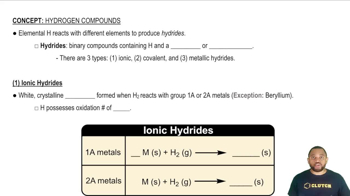
Hydrides

Hydrides are compounds formed between hydrogen and another element. They can be classified into ionic, covalent, and metallic hydrides, depending on the nature of the bond. Understanding the type of hydride formed is essential for predicting the properties and reactivity of the compound.
Video consigliato:

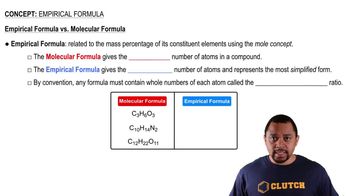
Empirical Formula

An empirical formula represents the simplest whole-number ratio of atoms in a compound. It provides essential information about the composition of the compound without detailing the actual number of atoms or the structure. This concept is crucial for identifying the correct hydride formed by the elements listed.
Video consigliato:
Percorso guidato
02:26
Empirical vs Molecular Formula

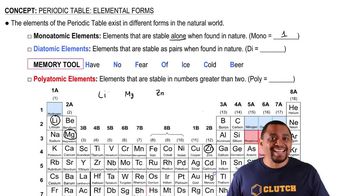
Element Properties

The properties of elements, such as electronegativity, atomic size, and bonding behavior, influence their ability to form hydrides. For instance, nonmetals like carbon and chlorine typically form covalent hydrides, while metals like tin can form ionic hydrides. Recognizing these properties helps in predicting which elements can form hydrides with hydrogen.
Video consigliato:
Percorso guidato
02:35
Elemental Forms of Elements