Ch.22 - The Main Group Elements
McMurry - Chemistry 8th Edition
McMurry8th EditionChemistryISBN: 9781292336145Non è quello che usi tu?Cambia libro di testo
Capitolo 22, Problema 22.26b

Look at the location of elements A, B, C, and D in the following periodic table:


(b) Classify each oxide as basic, acidic, or amphoteric.

Guida verificata passo dopo passo
1
insert step 1: Identify the location of each element (A, B, C, and D) on the periodic table. Elements on the left side are typically metals, while those on the right are nonmetals.
insert step 2: Recall that metal oxides are generally basic, nonmetal oxides are generally acidic, and oxides of elements that are metalloids or near the metal-nonmetal boundary can be amphoteric.
insert step 3: Determine the metallic or nonmetallic nature of each element based on its position in the periodic table.
insert step 4: Classify the oxide of each element based on its metallic or nonmetallic nature: basic for metals, acidic for nonmetals, and amphoteric for metalloids.
insert step 5: Review the classifications to ensure they align with the general trends of the periodic table and the properties of oxides.

Risposta video verificata per un problema simile:

Questa soluzione video è stata consigliata dai nostri tutor come utile per risolvere questo problema.

Concetti chiave

Ecco i concetti essenziali che devi comprendere per rispondere correttamente alla domanda.

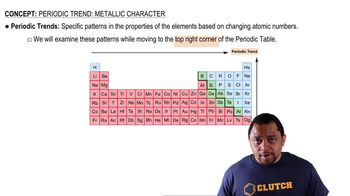
Periodic Trends

Periodic trends refer to the predictable patterns observed in the properties of elements as you move across or down the periodic table. These trends include atomic radius, ionization energy, and electronegativity, which influence how elements react and form compounds, including oxides.
Video consigliato:
Percorso guidato
00:38
Periodic Trends

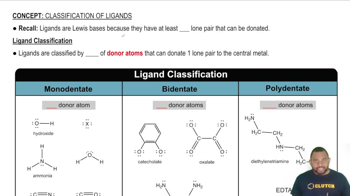
Oxide Classification

Oxides can be classified as basic, acidic, or amphoteric based on their chemical behavior with acids and bases. Basic oxides react with acids to form salts and water, acidic oxides react with bases, and amphoteric oxides can react with both acids and bases, demonstrating dual behavior.
Video consigliato:
Percorso guidato
04:22
Ligand Classification

Element Position and Reactivity

The position of an element in the periodic table significantly affects its reactivity and the nature of its oxides. Metals, typically found on the left side, tend to form basic oxides, while nonmetals, located on the right, usually form acidic oxides. Metalloids can form amphoteric oxides, bridging the two categories.
Video consigliato:
Percorso guidato
01:33
Lone Pair Positions