Ch.22 - The Main Group Elements
McMurry - Chemistry 8th Edition
McMurry8th EditionChemistryISBN: 9781292336145Non è quello che usi tu?Cambia libro di testo
Capitolo 22, Problema 22.40b

Which compound in each of the following pairs is more ionic?
(b) P4O6 or Ga2O3

Guida verificata passo dopo passo
1
Identify the elements involved in each compound: P4O6 contains phosphorus (P) and oxygen (O), while Ga2O3 contains gallium (Ga) and oxygen (O).
Recall that ionic character is generally higher when there is a greater difference in electronegativity between the elements involved.
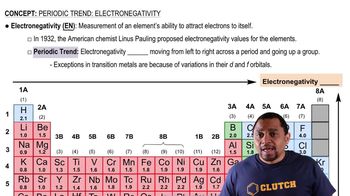
Look up the electronegativity values: Phosphorus (P) has an electronegativity of about 2.19, Gallium (Ga) has about 1.81, and Oxygen (O) has about 3.44.
Calculate the electronegativity difference for each compound: For P4O6, the difference is |3.44 - 2.19|, and for Ga2O3, it is |3.44 - 1.81|.
Compare the electronegativity differences: The compound with the larger difference is more ionic.

Risposta video verificata per un problema simile:

Questa soluzione video è stata consigliata dai nostri tutor come utile per risolvere questo problema.

Concetti chiave

Ecco i concetti essenziali che devi comprendere per rispondere correttamente alla domanda.

Ionic Character

Ionic character refers to the degree to which a bond between two atoms has ionic characteristics, as opposed to covalent characteristics. It is influenced by the difference in electronegativity between the two atoms involved in the bond. A larger difference in electronegativity typically indicates a more ionic bond, as one atom more effectively attracts the shared electrons.
Video consigliato:
Percorso guidato
00:56
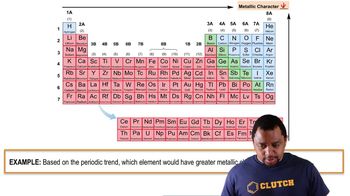
Metallic Character Example

Electronegativity

Electronegativity is a measure of an atom's ability to attract and hold onto electrons in a chemical bond. The Pauling scale is commonly used to quantify electronegativity values, with fluorine being the most electronegative element. When comparing compounds, the electronegativity of the constituent elements helps determine the nature of the bonds—whether they are more ionic or covalent.
Video consigliato:
Percorso guidato
02:10
Electronegativity Trends

Compound Classification

Compounds can be classified based on the types of bonds they contain, primarily ionic or covalent. Ionic compounds typically form between metals and nonmetals, where electrons are transferred, resulting in charged ions. In contrast, covalent compounds involve the sharing of electrons between nonmetals. Understanding the classification of compounds aids in predicting their properties and behaviors in chemical reactions.
Video consigliato:
Percorso guidato
04:22
Ligand Classification