Ch.23 - Organic and Biological Chemistry

McMurry8th EditionChemistryISBN: 9781292336145
Non è quello che usi tu?Cambia libro di testoScegli un libro di testo diverso
TOC.tableOfContents
- Ch.1 - Chemical Tools: Experimentation & Measurement170
- Ch.2 - Atoms, Molecules & Ions160
- Ch.3 - Mass Relationships in Chemical Reactions169
- Ch.4 - Reactions in Aqueous Solution199
- Ch.5 - Periodicity & Electronic Structure of Atoms102
- Ch.6 - Ionic Compounds: Periodic Trends and Bonding Theory92
- Ch.7 - Covalent Bonding and Electron-Dot Structures61
- Ch.8 - Covalent Compounds: Bonding Theories and Molecular Structure59
- Ch.9 - Thermochemistry: Chemical Energy122
- Ch.10 - Gases: Their Properties & Behavior155
- Ch.11 - Liquids & Phase Changes54
- Ch.12 - Solids and Solid-State Materials73
- Ch.13 - Solutions & Their Properties120
- Ch.14 - Chemical Kinetics98
- Ch.15 - Chemical Equilibrium125
- Ch.16 - Aqueous Equilibria: Acids & Bases110
- Ch.17 - Applications of Aqueous Equilibria147
- Ch.18 - Thermodynamics: Entropy, Free Energy & Equilibrium86
- Ch.19 - Electrochemistry154
- Ch.20 - Nuclear Chemistry96
- Ch.21 - Transition Elements and Coordination Chemistry156
- Ch.22 - The Main Group Elements187
- Ch.23 - Organic and Biological Chemistry51

Capitolo 23, Problema 81
Unlike palmerolide A (Problem 23.80), which has a large ring, a cyclic molecule with only six atoms can only have a cis double bond, but not a trans double bond. Give a line drawing of a cyclic molecule with six carbon atoms and a cis double bond. Explain why it cannot have a trans double bond.
 Guida verificata passo dopo passo
1
Step 1: Begin by drawing a hexagonal ring to represent a cyclic molecule with six carbon atoms. This is known as cyclohexene when it contains a double bond.
Step 2: Identify the position where the double bond will be placed. In cyclohexene, the double bond is typically between two adjacent carbon atoms.
Step 3: Draw the double bond between two of the carbon atoms in the ring. Ensure that the remaining carbon atoms are single-bonded to each other to complete the hexagonal structure.
Step 4: Add hydrogen atoms to each carbon atom to satisfy the tetravalency of carbon. Each carbon should have a total of four bonds, including the bonds in the ring and the double bond.
Step 5: Explain why a trans double bond is not possible in a six-membered ring. A trans double bond would require the substituents on the double-bonded carbons to be on opposite sides, which would introduce significant ring strain due to the geometric constraints of a small ring, making it energetically unfavorable.
Concetti chiave
Ecco i concetti essenziali che devi comprendere per rispondere correttamente alla domanda.
Cyclic Molecules
Cyclic molecules are compounds where carbon atoms are connected in a ring structure. In six-membered carbon rings, the spatial arrangement of atoms can significantly influence the types of bonds that can form. The rigidity of the ring limits the rotation around the carbon-carbon bonds, which is crucial for understanding the types of isomers that can exist.
Video consigliato:
Percorso guidato
 00:36
00:36
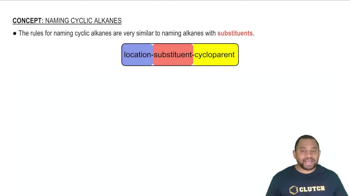
Rules for Naming Cyclic Alkanes
Cis and Trans Isomerism
Cis and trans isomerism refers to the different spatial arrangements of substituents around a double bond. In a cis configuration, substituents are on the same side of the double bond, while in a trans configuration, they are on opposite sides. The ability to form these isomers depends on the flexibility of the molecule; in cyclic structures, this flexibility is restricted, particularly for six-membered rings.
Video consigliato:
Percorso guidato
 3:33
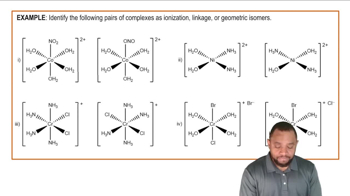
3:33Isomerism in Coordination Complexes Example
Steric Hindrance
Steric hindrance occurs when atoms in a molecule are forced into close proximity, leading to repulsion and instability. In a six-membered cyclic molecule with a trans double bond, the bulky groups on opposite sides would experience significant steric strain, making the configuration energetically unfavorable. This strain prevents the formation of stable trans isomers in such cyclic structures.
Pratica correlata