
A copper wire having a mass of 2.196 g was allowed to react with an excess of sulfur. The excess sulfur was then burned, yielding SO2 gas. The mass of the copper sulfide produced was 2.748 g. (a) What is the percent composition of copper sulfide?
Ch.3 - Mass Relationships in Chemical Reactions
Tutti i libri di testo
McMurry 8th Edition
Ch.3 - Mass Relationships in Chemical Reactions
Problema 118
McMurry 8th Edition
Ch.3 - Mass Relationships in Chemical Reactions
Problema 118Capitolo 3, Problema 118
Element X, a member of group 5A, forms two chlorides, XCl3 and XCl5. Reaction of an excess of Cl2 with 8.729 g of XCl3 yields 13.233 g of XCl5. What is the atomic weight and the identity of the element X?
Guida verificata passo dopo passo1
Identify the chemical reaction: XCl3 + Cl2 -> XCl5.
Calculate the mass of Cl2 used in the reaction by subtracting the mass of XCl3 from the mass of XCl5: mass of Cl2 = mass of XCl5 - mass of XCl3.
Determine the moles of Cl2 used by dividing the mass of Cl2 by the molar mass of Cl2 (70.90 g/mol).
Use stoichiometry to find the moles of XCl3 reacted, which is equal to the moles of Cl2 used, since the reaction is 1:1.
Calculate the molar mass of X by using the mass of XCl3 and the moles of XCl3: molar mass of X = (mass of XCl3 - (moles of XCl3 * molar mass of Cl3)) / moles of XCl3.

Risposta video verificata per un problema simile:
Questa soluzione video è stata consigliata dai nostri tutor come utile per risolvere questo problema.
Durata del video:
5mConcetti chiave
Ecco i concetti essenziali che devi comprendere per rispondere correttamente alla domanda.
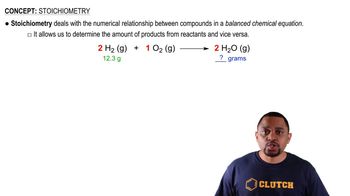
Stoichiometry
Stoichiometry is the calculation of reactants and products in chemical reactions. It involves using balanced chemical equations to determine the relationships between the quantities of substances consumed and produced. In this question, stoichiometry is essential for understanding how the mass of XCl3 relates to the mass of XCl5 formed during the reaction with Cl2.
Video consigliato:
Percorso guidato
Stoichiometry Concept
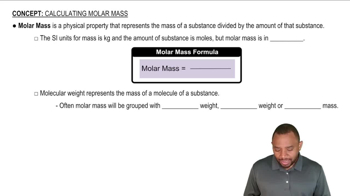
Molar Mass
Molar mass is the mass of one mole of a substance, typically expressed in grams per mole (g/mol). It is calculated by summing the atomic weights of all atoms in a molecule. In this problem, determining the molar mass of XCl3 and XCl5 is crucial for finding the atomic weight of element X, as it allows for the conversion of mass measurements into moles.
Video consigliato:
Percorso guidato
Molar Mass Concept
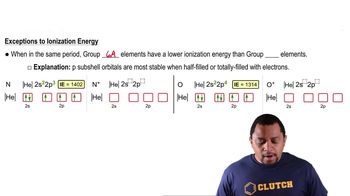
Group 5A Elements
Group 5A elements, also known as Group 15 in the periodic table, include nitrogen, phosphorus, arsenic, antimony, and bismuth. These elements typically exhibit a range of oxidation states and can form various compounds, including chlorides. Understanding the properties and common oxidation states of Group 5A elements is important for identifying element X and predicting its behavior in reactions.
Video consigliato:
Percorso guidato
Group 6A vs. Group 5A Elements
Pratica correlata
Domanda del libro di testo
604
views
Domanda del libro di testo
A copper wire having a mass of 2.196 g was allowed to react with an excess of sulfur. The excess sulfur was then burned, yielding SO2 gas. The mass of the copper sulfide produced was 2.748 g. (b) What is its empirical formula?
550
views
Domanda del libro di testo
Window glass is typically made by mixing soda ash (Na2CO3), limestone (CaCO3), and silica sand (SiO2) and then heating to 1500 °C to drive off CO2 from the (Na2CO3) and CaCO3. The resultant glass consists of about 12% Na2O by mass, 13% CaO by mass, and 75% SiO2 by mass. How much of each reactant would you start with to prepare 0.35 kg of glass?
1563
views
Domanda del libro di testo
Ammonium nitrate, a potential ingredient of terrorist bombs, can be made nonexplosive by addition of diammo-nium hydrogen phosphate, (NH4)2HPO4. Analysis of such a NH4NO3 - (NH4)2HPO4 mixture showed the mass percent of nitrogen to be 30.43%. What is the mass ratio of the two components in the mixture?
720
views
Domanda del libro di testo
When eaten, dietary carbohydrates are digested to yield glu-cose (C6H12O6), which is then metabolized to yield carbon dioxide and water:
Balance the equation, and calculate both the mass in grams and the volume in liters of the CO2 produced from 66.3 g of glucose, assuming that 1 mol of CO2 has a volume of 25.4 L at normal body temperature.
525
views