
Ch.3 - Mass Relationships in Chemical Reactions
McMurry - Chemistry 8th Edition
McMurry8th EditionChemistryISBN: 9781292336145Non è quello che usi tu?Cambia libro di testo
Capitolo 3, Problema 121

Window glass is typically made by mixing soda ash (Na2CO3), limestone (CaCO3), and silica sand (SiO2) and then heating to 1500 °C to drive off CO2 from the (Na2CO3) and CaCO3. The resultant glass consists of about 12% Na2O by mass, 13% CaO by mass, and 75% SiO2 by mass. How much of each reactant would you start with to prepare 0.35 kg of glass?

Guida verificata passo dopo passo
1
Step 1: Determine the mass of each component in the final glass.
Step 2: Calculate the moles of each oxide in the glass using their molar masses.
Step 3: Use stoichiometry to find the moles of each reactant needed to produce the calculated moles of oxides.
Step 4: Convert the moles of each reactant back to mass using their respective molar masses.
Step 5: Sum the masses of the reactants to ensure they add up to the total mass of the glass.

Risposta video verificata per un problema simile:

Questa soluzione video è stata consigliata dai nostri tutor come utile per risolvere questo problema.
Durata del video:
10m

Concetti chiave

Ecco i concetti essenziali che devi comprendere per rispondere correttamente alla domanda.

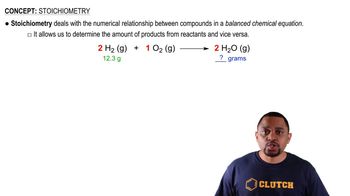
Stoichiometry

Stoichiometry is the calculation of reactants and products in chemical reactions based on the conservation of mass. It involves using balanced chemical equations to determine the proportions of substances needed or produced in a reaction. Understanding stoichiometry is essential for determining how much of each reactant is required to produce a specific amount of product, such as glass in this case.
Video consigliato:
Percorso guidato
01:16
Stoichiometry Concept

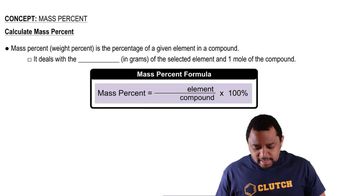
Mass Percent Composition

Mass percent composition refers to the percentage by mass of each component in a compound. It is calculated by dividing the mass of the individual component by the total mass of the compound and multiplying by 100. In the context of the glass composition provided, knowing the mass percent of Na2O, CaO, and SiO2 allows for the calculation of the required amounts of each reactant to achieve the desired mass of glass.
Video consigliato:
Percorso guidato
00:38
Mass Percent Calculation

Decomposition Reactions

Decomposition reactions involve the breakdown of a compound into simpler substances, often requiring heat. In the preparation of glass, heating soda ash and limestone drives off carbon dioxide (CO2), which is a key step in forming the final glass product. Understanding this process is crucial for determining how much of the original reactants is needed to account for the loss of mass during the reaction.
Video consigliato:
Percorso guidato
01:30
Alcohol Reactions: Dehydration Reactions
Pratica correlata
Domanda del libro di testo
An unidentified metal M reacts with an unidentified halogen X to form a compound MX2. When heated, the compound decomposes by the reaction: When 1.12 g of MX2 is heated, 0.720 g of MX is obtained, along with 56.0 mL of X2 gas. Under the conditions used, 1.00 mol of the gas has a volume of 22.41 L. (a) What is the atomic weight and identity of the halogen X?
517
views
Domanda del libro di testo

Ammonium nitrate, a potential ingredient of terrorist bombs, can be made nonexplosive by addition of diammo-nium hydrogen phosphate, (NH4)2HPO4. Analysis of such a NH4NO3 - (NH4)2HPO4 mixture showed the mass percent of nitrogen to be 30.43%. What is the mass ratio of the two components in the mixture?

720
views
Domanda del libro di testo
Ethylene glycol, commonly used as automobile antifreeze, contains only carbon, hydrogen, and oxygen. Combustion analysis of a 23.46 mg sample yields 20.42 mg of H2O and 33.27 mg of CO2. What is the empirical formula of ethylene glycol? What is its molecular formula if it has a molecular weight of 62.0?
1266
views
1
rank
Domanda del libro di testo

(a) Polychlorinated biphenyls (PCBs) were compounds used as coolants in transformers and capacitors, but their production was banned by the U.S. Congress in 1979 because they are highly toxic and persist in the environment. When 1.0 g of a PCB containing carbon, hydrogen, and chlorine was subjected to combustion analysis, 1.617 g of CO2. and 0.138 g of H2O were produced. What is the empirical formula?

701
views
Domanda del libro di testo
Element X, a member of group 5A, forms two chlorides, XCl3 and XCl5. Reaction of an excess of Cl2 with 8.729 g of XCl3 yields 13.233 g of XCl5. What is the atomic weight and the identity of the element X?
628
views