Ch.3 - Mass Relationships in Chemical Reactions
McMurry - Chemistry 8th Edition
McMurry8th EditionChemistryISBN: 9781292336145Non è quello che usi tu?Cambia libro di testo
Capitolo 3, Problema 162

Name the following binary compounds of nitrogen and oxygen: (a) NO (b) N2O (c) NO2 (d) N2O4 (e) N2O5

Guida verificata passo dopo passo
1
Identify the type of compound: These are binary compounds composed of two nonmetals, nitrogen (N) and oxygen (O).
Use the prefix system for naming binary molecular compounds: The prefixes mono-, di-, tri-, tetra-, penta-, etc., indicate the number of atoms of each element in the compound.
For compound (a) NO: The prefix 'mono-' is often omitted for the first element, so it is named nitrogen monoxide.
For compound (b) N2O: Use the prefix 'di-' for two nitrogen atoms and 'mono-' for one oxygen atom, resulting in dinitrogen monoxide.
For compound (c) NO2: Use the prefix 'di-' for two oxygen atoms, resulting in nitrogen dioxide.

Risposta video verificata per un problema simile:

Questa soluzione video è stata consigliata dai nostri tutor come utile per risolvere questo problema.
Durata del video:
7m

Concetti chiave

Ecco i concetti essenziali che devi comprendere per rispondere correttamente alla domanda.

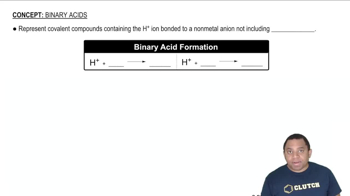
Binary Compounds

Binary compounds consist of two different elements. In the context of the question, nitrogen and oxygen are the two elements forming various binary compounds. The naming of these compounds follows specific rules based on the number of atoms of each element present, which is crucial for correctly identifying each compound.
Video consigliato:

Naming Conventions

The naming of binary compounds typically involves using prefixes to indicate the number of atoms of each element. For example, 'mono-' for one, 'di-' for two, 'tri-' for three, and so on. The first element retains its name, while the second element's name is modified to end in '-ide.' Understanding these conventions is essential for accurately naming the compounds listed in the question.
Video consigliato:
Percorso guidato
00:39
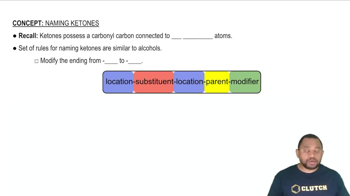
Rules for Naming Ketones

Oxidation States

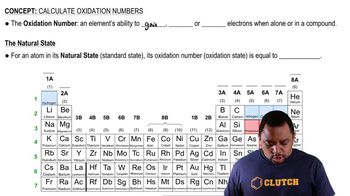
Oxidation states indicate the degree of oxidation of an atom in a compound, which helps in understanding the compound's structure and reactivity. In the case of nitrogen and oxygen, knowing the common oxidation states (e.g., nitrogen can have oxidation states of -3, 0, +1, +2, +3, +4, +5, and oxygen typically has -2) aids in determining the correct names for the compounds based on their molecular formulas.
Video consigliato:
Percorso guidato
02:42
Oxidation Numbers