Ch.4 - Reactions in Aqueous Solution
McMurry - Chemistry 8th Edition
McMurry8th EditionChemistryISBN: 9781292336145Non è quello che usi tu?Cambia libro di testo
Capitolo 4, Problema 93a

A 250.0 g sample of a white solid is known to be a mixture of KNO3, BaCl2, and NaCl. When 100.0 g of this mixture is dis-solved in water and allowed to react with excess H2SO4, 67.3 g of a white precipitate is collected. When the remaining 150.0 g of the mixture is dissolved in water and allowed to react with excess AgNO3, 197.6 g of a second precipitate is collected. (a) What are the formulas of the two precipitates?

Guida verificata passo dopo passo
1
Identify the possible reactions that can occur when the mixture is treated with H2SO4 and AgNO3.
Consider the solubility rules to determine which compounds will form precipitates with H2SO4 and AgNO3.
For the reaction with H2SO4, recognize that BaCl2 will react to form BaSO4, a common insoluble sulfate.
For the reaction with AgNO3, recognize that both BaCl2 and NaCl can form AgCl, a common insoluble chloride.
Conclude that the first precipitate is BaSO4 and the second precipitate is AgCl.

Risposta video verificata per un problema simile:

Questa soluzione video è stata consigliata dai nostri tutor come utile per risolvere questo problema.
Durata del video:
3m

Concetti chiave

Ecco i concetti essenziali che devi comprendere per rispondere correttamente alla domanda.

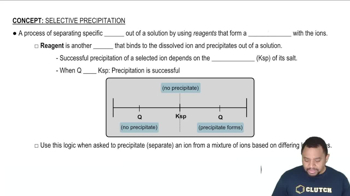
Precipitation Reactions

Precipitation reactions occur when two soluble salts react in solution to form an insoluble product, known as a precipitate. This process is driven by the formation of a compound that has low solubility in water, leading to its separation from the solution. Understanding the solubility rules helps predict which combinations of ions will result in a precipitate.
Video consigliato:
Percorso guidato
01:53
Selective Precipitation

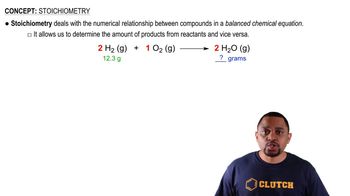
Stoichiometry

Stoichiometry is the calculation of reactants and products in chemical reactions based on the conservation of mass. It involves using balanced chemical equations to determine the amounts of substances consumed and produced. In this context, stoichiometry is essential for relating the masses of the precipitates to the amounts of the original mixture components.
Video consigliato:
Percorso guidato
01:16
Stoichiometry Concept

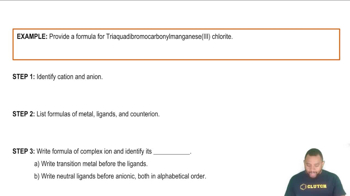
Chemical Formulas and Compounds

Chemical formulas represent the composition of compounds, indicating the types and numbers of atoms present. In this question, identifying the precipitates requires knowledge of the chemical formulas for the compounds involved, such as KNO3, BaCl2, and NaCl, and their reactions with H2SO4 and AgNO3. Recognizing the products formed from these reactions is crucial for determining the precipitates.
Video consigliato:
Percorso guidato
03:37
Writing Formulas of Coordination Compounds Example