Ch.4 - Reactions in Aqueous Solution
McMurry - Chemistry 8th Edition
McMurry8th EditionChemistryISBN: 9781292336145Non è quello che usi tu?Cambia libro di testo
Capitolo 4, Problema 92b

The following three solutions are mixed: 100.0 mL of 0.100 M Na2SO4, 50.0 mL of 0.300 M ZnCl2, and 100.0 mL of 0.200 M Ba(CN)2. (b) What is the molarity of each ion remaining in the solution assuming complete precipitation of all insoluble compounds?

Guida verificata passo dopo passo
1
Calculate the initial moles of each ion in the solutions. For Na2SO4, use the formula: moles = molarity \(\times\) volume (in liters). Do the same for ZnCl2 and Ba(CN)2.
Write down the possible precipitation reactions that could occur based on the ions present in the solutions. Consider the solubility rules to determine which compounds are likely to precipitate.
For each potential precipitate, use the stoichiometry of the reaction to determine how many moles of each ion would be needed to form the precipitate. Compare this to the moles available in the solution to find the limiting reactant.
Subtract the moles of ions that precipitate from the initial moles to find the moles of each ion remaining in the solution.
Calculate the final molarity of each ion by dividing the remaining moles of each ion by the total volume of the solution in liters.

Risposta video verificata per un problema simile:

Questa soluzione video è stata consigliata dai nostri tutor come utile per risolvere questo problema.
Durata del video:
12m

Concetti chiave

Ecco i concetti essenziali che devi comprendere per rispondere correttamente alla domanda.

Molarity

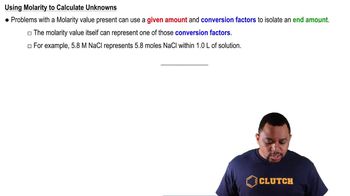
Molarity is a measure of concentration defined as the number of moles of solute per liter of solution. It is expressed in moles per liter (M) and is crucial for calculating the amounts of ions present in a solution after mixing different solutions. Understanding molarity allows for the determination of how much of each ion will remain in the solution after any reactions, such as precipitation.
Video consigliato:

Precipitation Reactions

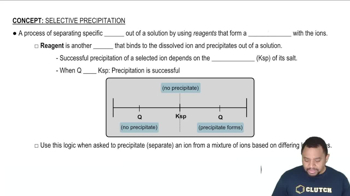
Precipitation reactions occur when two soluble salts react in solution to form an insoluble compound, or precipitate. This process is essential in the context of the question, as it determines which ions will remain in solution and which will form solid precipitates. Identifying the solubility rules helps predict the formation of precipitates and the resulting concentrations of ions in the final solution.
Video consigliato:
Percorso guidato
01:53
Selective Precipitation

Stoichiometry

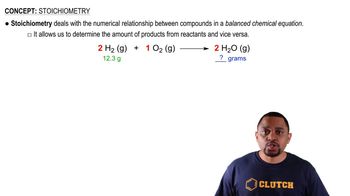
Stoichiometry involves the calculation of reactants and products in chemical reactions based on balanced chemical equations. It is vital for determining the amounts of ions produced or consumed during reactions, including precipitation. By applying stoichiometric principles, one can calculate the remaining concentrations of ions after the complete precipitation of insoluble compounds in the mixed solutions.
Video consigliato:
Percorso guidato
01:16
Stoichiometry Concept