
Ch.4 - Reactions in Aqueous Solution
McMurry - Chemistry 8th Edition
McMurry8th EditionChemistryISBN: 9781292336145Non è quello che usi tu?Cambia libro di testo
Capitolo 4, Problema 123a

(a) Use the following reactions to arrange the elements A, B, C, and D in order of their decreasing ability as reducing agents:

Guida verificata passo dopo passo
1
insert step 1
insert step 2
insert step 3
insert step 4
insert step 5

Risposta video verificata per un problema simile:

Questa soluzione video è stata consigliata dai nostri tutor come utile per risolvere questo problema.
Durata del video:
4m

Concetti chiave

Ecco i concetti essenziali che devi comprendere per rispondere correttamente alla domanda.

Reducing Agents

A reducing agent is a substance that donates electrons in a chemical reaction, thereby reducing another substance. The strength of a reducing agent is determined by its ability to lose electrons easily. Elements that are more electropositive, such as alkali metals, typically serve as stronger reducing agents due to their low ionization energies.
Video consigliato:
Percorso guidato
01:01
Oxidizing and Reducing Agents

Electrochemical Series

The electrochemical series is a list of elements arranged by their standard electrode potentials. This series helps predict the tendency of a substance to act as a reducing or oxidizing agent. Elements higher in the series are more likely to be reduced, while those lower are more likely to be oxidized, thus serving as stronger reducing agents.
Video consigliato:
Percorso guidato
02:46
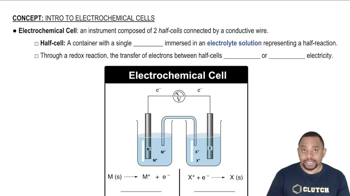
Electrochemical Cells

Reaction Context

The context of the reactions provided is crucial for determining the reducing abilities of elements A, B, C, and D. Different reactions can highlight different properties of the elements, such as their reactivity with specific oxidizing agents. Analyzing the products and conditions of these reactions will provide insight into the relative strengths of the reducing agents.
Video consigliato:
Percorso guidato
01:30
Alcohol Reactions: Dehydration Reactions