(a) Use the following reactions to arrange the elements A, B, C, and D in order of their decreasing ability as reducing agents:
Ch.4 - Reactions in Aqueous Solution
Capitolo 4, Problema 121
Neither strontium (Sr) nor antimony (Sb) is shown in the activity series of Table 4.5. Based on their positions in the periodic table, which would you expect to be the better reducing agent? Will the following reaction occur? Explain.
Guida verificata passo dopo passo1
insert step 1> Identify the positions of strontium (Sr) and antimony (Sb) in the periodic table. Strontium is an alkaline earth metal in Group 2, while antimony is a metalloid in Group 15.
insert step 2> Recall that elements in Group 2, like strontium, are typically more reactive metals and are often good reducing agents because they tend to lose electrons easily.
insert step 3> Consider the general trend in the periodic table where metals, especially those in the s-block, are better reducing agents compared to metalloids and nonmetals.
insert step 4> Conclude that strontium (Sr), being a more reactive metal, is likely to be a better reducing agent than antimony (Sb).
insert step 5> To determine if a reaction will occur, consider the reactivity of the elements involved. If strontium is a better reducing agent, it is more likely to participate in redox reactions compared to antimony.

Risposta video verificata per un problema simile:
Questa soluzione video è stata consigliata dai nostri tutor come utile per risolvere questo problema.
Durata del video:
1mConcetti chiave
Ecco i concetti essenziali che devi comprendere per rispondere correttamente alla domanda.
Reducing Agents
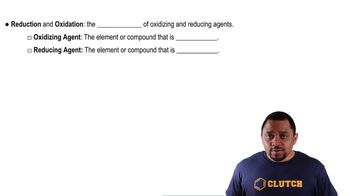
A reducing agent is a substance that donates electrons in a chemical reaction, thereby reducing another substance. The strength of a reducing agent is often determined by its position in the activity series, where metals higher in the series are generally better at losing electrons. Understanding the properties of strontium and antimony, including their electron configurations and reactivity, is essential for determining which is the better reducing agent.
Video consigliato:
Percorso guidato
Oxidizing and Reducing Agents
Activity Series
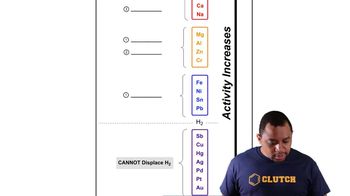
The activity series is a list of metals ranked by their ability to displace other metals from compounds in solution. Metals higher in the series are more reactive and can act as reducing agents more effectively. Since strontium is an alkaline earth metal and typically more reactive than antimony, which is a metalloid, this series helps predict the likelihood of a reaction occurring between these elements.
Video consigliato:
Percorso guidato
Activity Series Chart
Periodic Trends
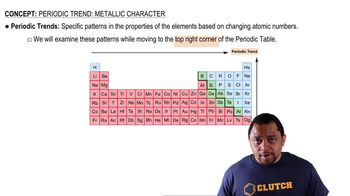
Periodic trends refer to the predictable patterns in elemental properties across the periodic table, such as electronegativity, ionization energy, and atomic radius. These trends influence the reactivity of elements; for instance, as you move down a group, metallic character increases, making elements more likely to act as reducing agents. Analyzing the positions of strontium and antimony in the periodic table provides insight into their relative reactivity and potential to participate in redox reactions.
Video consigliato:
Percorso guidato
Periodic Trends
Pratica correlata
Domanda del libro di testo
429
views
Domanda del libro di testo
Use the activity series of metals (Table 4.5) to predict the outcome of each of the following reactions. If no reaction occurs, write NR. (d)
495
views
Domanda del libro di testo
Use the activity series of metals (Table 4.5) to predict the outcome of each of the following reactions. If no reaction occurs, write NR. (b)
413
views
Domanda del libro di testo
(a) Use the following reactions to arrange the elements A, B, C, and D in order of their decreasing ability as reducing agents:
313
views
Domanda del libro di testo
(b) Which of the following reactions would you expect to occur according to the activity series you established in part (a)?
326
views
Domanda del libro di testo
Use the activity series of metals (Table 4.5) to predict the outcome of each of the following reactions. If no reaction occurs, write NR. (c)
348
views