Ch.4 - Reactions in Aqueous Solution
McMurry - Chemistry 8th Edition
McMurry8th EditionChemistryISBN: 9781292336145Non è quello che usi tu?Cambia libro di testo
Capitolo 4, Problema 108e

Assign oxidation numbers to each element in the following compounds. (e) KClO3

Guida verificata passo dopo passo
1
Identify the oxidation number of potassium (K). Since K is an alkali metal, it typically has an oxidation number of +1.
Assign the oxidation number of oxygen (O). In most compounds, oxygen has an oxidation number of -2.
Let the oxidation number of chlorine (Cl) be x. Write the equation based on the sum of oxidation numbers in the compound KClO3, which must equal zero: +1 (for K) + x (for Cl) + 3(-2) (for O) = 0.
Simplify the equation: +1 + x - 6 = 0.
Solve for x to find the oxidation number of chlorine.

Risposta video verificata per un problema simile:

Questa soluzione video è stata consigliata dai nostri tutor come utile per risolvere questo problema.
Durata del video:
6m

Concetti chiave

Ecco i concetti essenziali che devi comprendere per rispondere correttamente alla domanda.

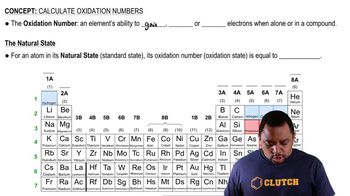
Oxidation Numbers

Oxidation numbers are assigned to atoms in a compound to indicate the degree of oxidation or reduction. They help in understanding electron transfer during chemical reactions. The rules for assigning oxidation numbers include that the oxidation number of an element in its elemental form is zero, and for monoatomic ions, it equals the charge of the ion.
Video consigliato:
Percorso guidato
02:42
Oxidation Numbers

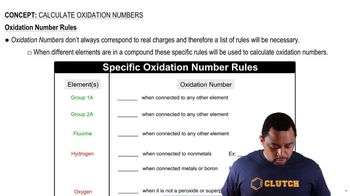
Rules for Assigning Oxidation Numbers

There are specific rules for assigning oxidation numbers, such as oxygen typically having an oxidation number of -2, hydrogen being +1 when bonded to non-metals, and alkali metals (like potassium) always having an oxidation number of +1. In compounds, the sum of oxidation numbers must equal the overall charge of the molecule or ion.
Video consigliato:
Percorso guidato
03:13
Oxidation Number Rules

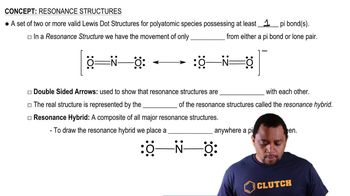
KClO3 Structure

KClO3, or potassium chlorate, consists of potassium (K), chlorine (Cl), and three oxygen (O) atoms. Understanding the structure is crucial for assigning oxidation numbers, as the oxidation state of chlorine can vary depending on its bonding with oxygen. In KClO3, chlorine typically has an oxidation number of +5, balancing the -6 contribution from the three oxygen atoms.
Video consigliato:
Percorso guidato
01:42
Resonance Structures