
Ch.4 - Reactions in Aqueous Solution
McMurry - Chemistry 8th Edition
McMurry8th EditionChemistryISBN: 9781292336145Non è quello che usi tu?Cambia libro di testo
Capitolo 4, Problema 86

Assume that you have an aqueous mixture of NaNO3 and AgNO3. How could you use a precipitation reaction to separate the two metal ions?

Guida verificata passo dopo passo
1
Identify the ions present in the solution: Na^+, Ag^+, and NO_3^-.
Recognize that Ag^+ can form a precipitate with Cl^- ions, while Na^+ remains soluble.
Add a source of Cl^- ions, such as NaCl or HCl, to the solution to initiate the precipitation reaction.
The reaction Ag^+ + Cl^- \(\rightarrow\) AgCl(s) will occur, forming a white precipitate of AgCl.
Filter the mixture to separate the solid AgCl from the aqueous Na^+ and NO_3^- ions.

Risposta video verificata per un problema simile:

Questa soluzione video è stata consigliata dai nostri tutor come utile per risolvere questo problema.
Durata del video:
3m

Concetti chiave

Ecco i concetti essenziali che devi comprendere per rispondere correttamente alla domanda.

Precipitation Reactions

Precipitation reactions occur when two soluble salts react in solution to form an insoluble solid, known as a precipitate. This process is driven by the formation of a compound that is less soluble than the reactants, leading to its separation from the solution. In the context of separating metal ions, identifying a suitable reagent that will selectively precipitate one ion while leaving the other in solution is crucial.
Video consigliato:
Percorso guidato
01:53
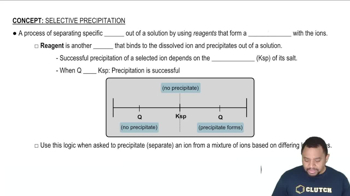
Selective Precipitation

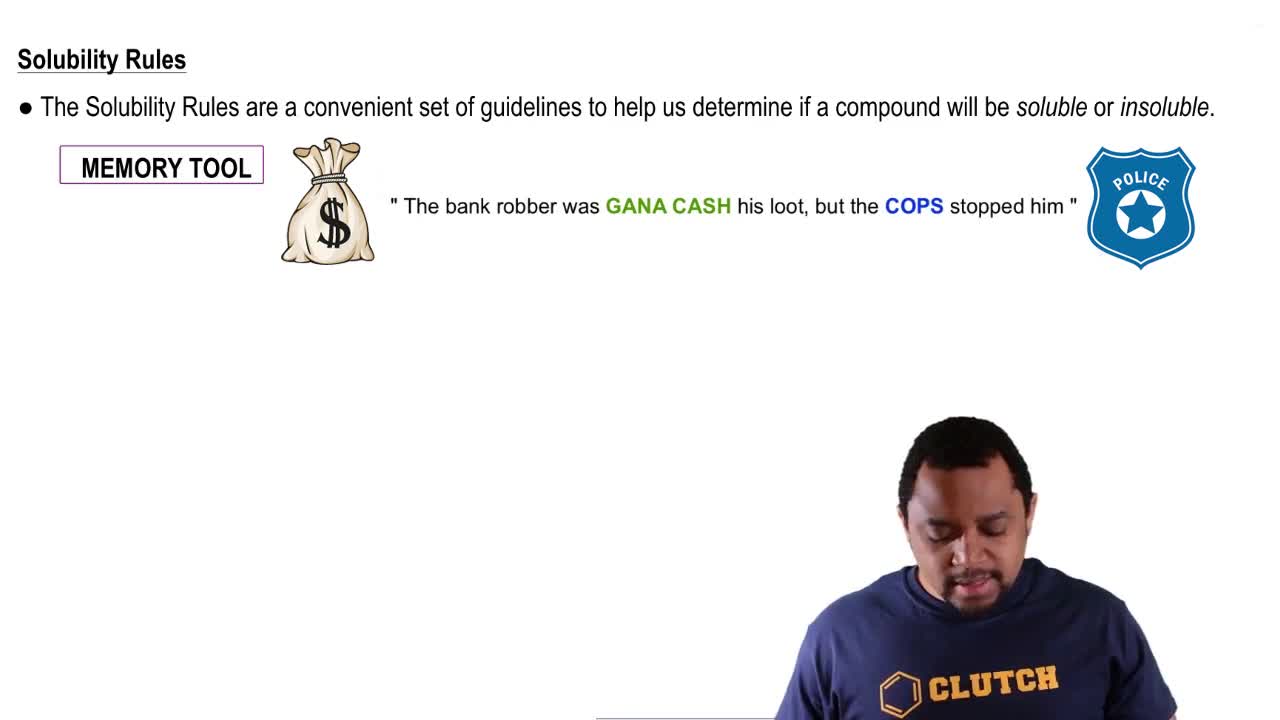
Solubility Rules

Solubility rules are guidelines that help predict whether a compound will dissolve in water. For example, most nitrates are soluble, but certain metal salts may be insoluble. Understanding these rules is essential for determining which ions can be precipitated from a mixture, as it informs the choice of reagents that will selectively react with one metal ion over another.
Video consigliato:
Percorso guidato
00:28
Solubility Rules

Selective Precipitation

Selective precipitation is a technique used to separate ions in a solution based on their differing solubilities. By adding a reagent that forms a precipitate with one ion while leaving the other ion in solution, it is possible to isolate the desired metal. This method is particularly useful in analytical chemistry for purifying compounds or separating components in a mixture.
Video consigliato:
Percorso guidato
01:53
Selective Precipitation