Ch.4 - Reactions in Aqueous Solution
McMurry - Chemistry 8th Edition
McMurry8th EditionChemistryISBN: 9781292336145Non è quello che usi tu?Cambia libro di testo
Capitolo 4, Problema 82b

How would you prepare the following substances by a precipitation reaction? (b) Mg3(PO4)2

Guida verificata passo dopo passo
1
Step 1: Identify two soluble compounds that contain the ions you need. In this case, we need Mg2+ and PO4^3-. A possible choice could be MgCl2 and Na3PO4, both of which are soluble in water.
Step 2: Write down the balanced chemical equation for the reaction. The equation is: 3MgCl2(aq) + 2Na3PO4(aq) -> Mg3(PO4)2(s) + 6NaCl(aq).
Step 3: Mix the solutions of the two compounds. The Mg2+ ions from the MgCl2 will react with the PO4^3- ions from the Na3PO4 to form Mg3(PO4)2, which is insoluble and will precipitate out of the solution.
Step 4: Separate the precipitate from the solution. This can be done by filtration. The solid Mg3(PO4)2 will remain on the filter, while the soluble NaCl will pass through.
Step 5: Dry the precipitate to obtain the pure Mg3(PO4)2.

Risposta video verificata per un problema simile:

Questa soluzione video è stata consigliata dai nostri tutor come utile per risolvere questo problema.
Durata del video:
1m

Concetti chiave

Ecco i concetti essenziali che devi comprendere per rispondere correttamente alla domanda.

Precipitation Reaction

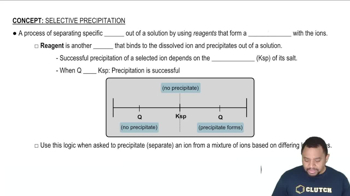
A precipitation reaction occurs when two soluble salts react in solution to form an insoluble product, known as a precipitate. This process typically involves the exchange of ions between the reactants, leading to the formation of a solid that separates from the liquid phase. Understanding the solubility rules is crucial for predicting whether a precipitate will form.
Video consigliato:
Percorso guidato
01:53
Selective Precipitation

Solubility Rules

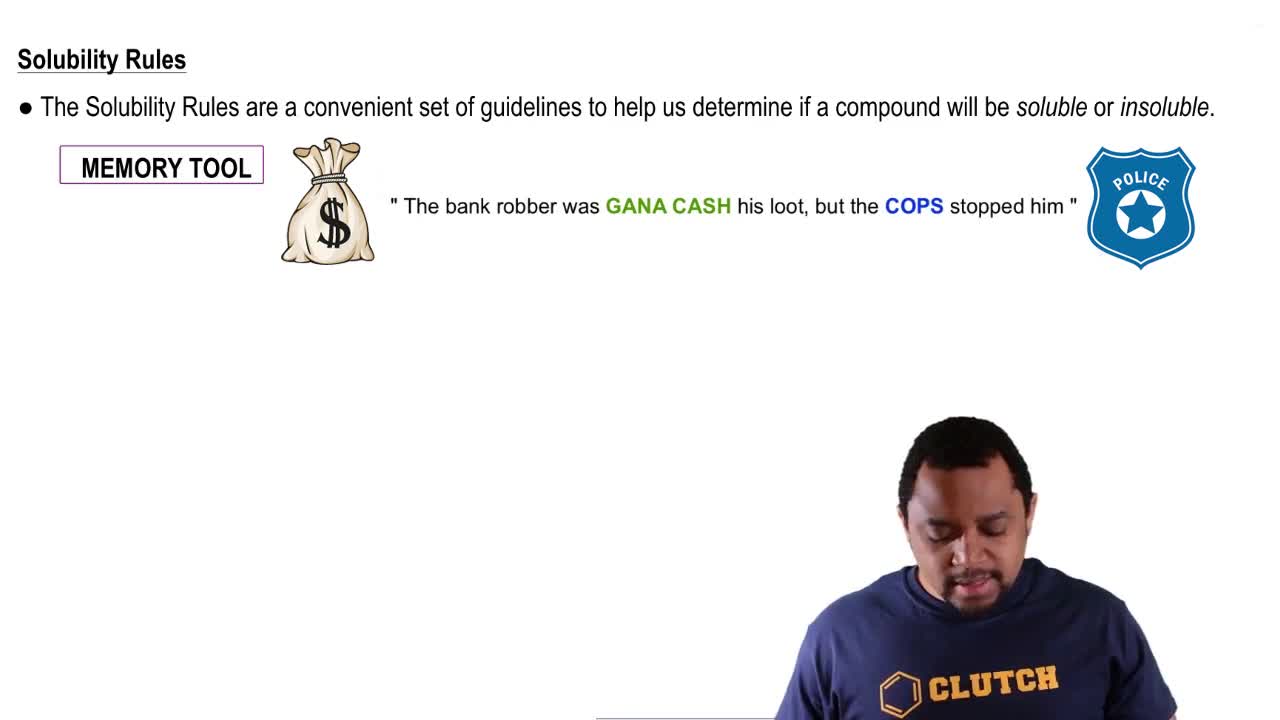
Solubility rules are guidelines that help predict the solubility of various ionic compounds in water. For example, most phosphates are insoluble except for those of alkali metals and ammonium. Knowing these rules allows chemists to determine which reactants will yield a precipitate when mixed, which is essential for preparing compounds like Mg3(PO4)2.
Video consigliato:
Percorso guidato
00:28
Solubility Rules

Ionic Compounds

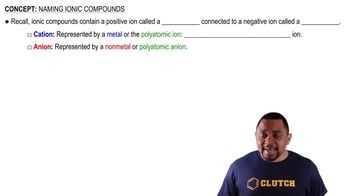
Ionic compounds are formed from the electrostatic attraction between positively charged cations and negatively charged anions. In the case of Mg3(PO4)2, magnesium ions (Mg²⁺) and phosphate ions (PO4³⁻) combine in a specific ratio to create a neutral compound. Understanding the composition and stoichiometry of ionic compounds is vital for successfully conducting precipitation reactions.
Video consigliato:
Percorso guidato
02:11
Ionic Compounds Naming