How many grams of solute would you use to prepare each of the following solutions? (a) 250.0 mL of 0.600 M ethyl alcohol (C2H6O)
Ch.4 - Reactions in Aqueous Solution
Capitolo 4, Problema 46b
How many moles of solute are present in each of the following solutions? (b) 175 mL of 0.67 M glucose (C6H12O6)
Guida verificata passo dopo passo1
Identify the formula for calculating moles from molarity: \( \text{Moles} = \text{Molarity} \times \text{Volume in Liters} \).
Convert the volume from milliliters to liters by dividing by 1000: \( 175 \text{ mL} = 0.175 \text{ L} \).
Substitute the given values into the formula: \( \text{Moles} = 0.67 \text{ M} \times 0.175 \text{ L} \).
Perform the multiplication to find the number of moles of glucose.
Ensure the units are consistent and the calculation is correct.

Risposta video verificata per un problema simile:
Questa soluzione video è stata consigliata dai nostri tutor come utile per risolvere questo problema.
Durata del video:
51sConcetti chiave
Ecco i concetti essenziali che devi comprendere per rispondere correttamente alla domanda.
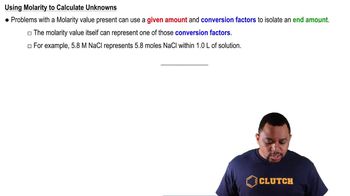
Molarity
Molarity (M) is a measure of concentration defined as the number of moles of solute per liter of solution. It is expressed in moles per liter (mol/L) and is crucial for calculating the amount of solute in a given volume of solution. In this question, the molarity of the glucose solution is given as 0.67 M, indicating that there are 0.67 moles of glucose in every liter of solution.
Video consigliato:
Percorso guidato
Molarity
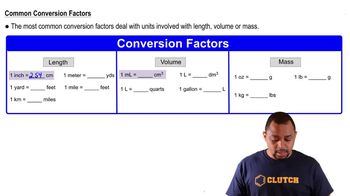
Volume Conversion
To calculate the number of moles of solute, it is essential to convert the volume of the solution from milliliters to liters, as molarity is defined in terms of liters. Since 1 liter equals 1000 milliliters, the volume of 175 mL can be converted to liters by dividing by 1000, resulting in 0.175 L. This conversion is a critical step in the calculation process.
Video consigliato:
Percorso guidato
Common Conversion Factors
Calculating Moles from Molarity
The number of moles of solute can be calculated using the formula: moles = molarity × volume (in liters). By multiplying the molarity of the solution (0.67 M) by the converted volume (0.175 L), one can determine the total moles of glucose present in the solution. This relationship is fundamental in stoichiometry and solution chemistry.
Video consigliato:
Percorso guidato
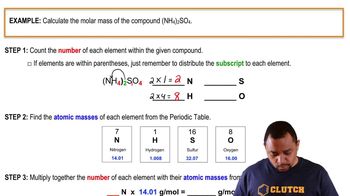
Molar Mass Calculation Example
Pratica correlata
Domanda del libro di testo
718
views
Domanda del libro di testo
How many moles of solute are present in each of the following solutions? (a) 35.0 mL of 1.200 M HNO3
883
views
Domanda del libro di testo
How many grams of solute would you use to prepare each of the following solutions? (b) 167 mL of 0.200 M boric acid (H3BO3)
620
views
Domanda del libro di testo
How many milliliters of a 0.45 M BaCl2 solution contain 15.0 g of BaCl2?
969
views
1
rank
Domanda del libro di testo
The following two redox reactions occur between aqueous cations and solid metals. Will a solution of green cations react with solid blue metal? Explain.
(a)
(b)
351
views
Domanda del libro di testo
Based on the positions in the periodic table, which of the following reactions would you expect to occur? (a) Red+ + Green → Red + Green+ (b) Blue + Green+ → Blue+ + Green (c) Red + Blue+ → Red+ + Blue
411
views