

Ch.4 - Reactions in Aqueous Solution
McMurry - Chemistry 8th Edition
McMurry8th EditionChemistryISBN: 9781292336145Non è quello che usi tu?Cambia libro di testo
Capitolo 4, Problema 103

Oxalic acid, H2C2O4, is a toxic substance found in spinach leaves. What is the molarity of a solution made by dissolving 12.0 g of oxalic acid in enough water to give 400.0 mL of solution? How many milliliters of 0.100 M KOH would you need to titrate 25.0 mL of the oxalic acid solution according to the following equation?

Guida verificata passo dopo passo
1
Calculate the molar mass of oxalic acid, \( \text{H}_2\text{C}_2\text{O}_4 \), by adding the atomic masses of its constituent atoms: 2 hydrogen atoms, 2 carbon atoms, and 4 oxygen atoms.
Determine the number of moles of oxalic acid by dividing the mass of oxalic acid (12.0 g) by its molar mass.
Calculate the molarity of the oxalic acid solution by dividing the number of moles of oxalic acid by the volume of the solution in liters (400.0 mL converted to liters).
Write the balanced chemical equation for the reaction between oxalic acid and KOH: \( \text{H}_2\text{C}_2\text{O}_4 + 2\text{KOH} \rightarrow \text{K}_2\text{C}_2\text{O}_4 + 2\text{H}_2\text{O} \).
Use the stoichiometry of the balanced equation to determine the volume of 0.100 M KOH needed to titrate 25.0 mL of the oxalic acid solution, considering the 1:2 mole ratio between oxalic acid and KOH.

Risposta video verificata per un problema simile:

Questa soluzione video è stata consigliata dai nostri tutor come utile per risolvere questo problema.
Durata del video:
1m

Concetti chiave

Ecco i concetti essenziali che devi comprendere per rispondere correttamente alla domanda.

Molarity

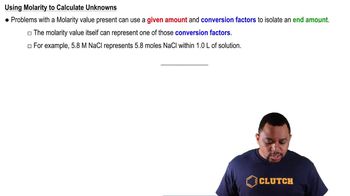
Molarity is a measure of concentration defined as the number of moles of solute per liter of solution. It is expressed in units of moles per liter (M). To calculate molarity, one must first determine the number of moles of the solute, which can be found by dividing the mass of the solute by its molar mass, and then divide that by the volume of the solution in liters.
Video consigliato:

Titration

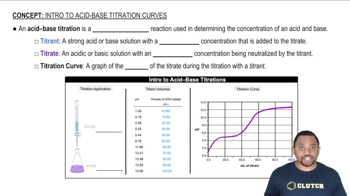
Titration is a quantitative analytical technique used to determine the concentration of a solute in a solution. It involves the gradual addition of a titrant of known concentration to a solution of the analyte until the reaction reaches its endpoint, which is often indicated by a color change. The volume of titrant used allows for the calculation of the analyte's concentration based on stoichiometry.
Video consigliato:
Percorso guidato
03:04
Acid-Base Titration

Stoichiometry

Stoichiometry is the calculation of reactants and products in chemical reactions based on the balanced chemical equation. It allows chemists to predict the amounts of substances consumed and produced in a reaction. In the context of titration, stoichiometry is essential for determining how much titrant is needed to completely react with a given volume of the analyte, based on their molar ratios.
Video consigliato:
Percorso guidato
01:16
Stoichiometry Concept