Ch.4 - Reactions in Aqueous Solution
McMurry - Chemistry 8th Edition
McMurry8th EditionChemistryISBN: 9781292336145Non è quello che usi tu?Cambia libro di testo
Capitolo 4, Problema 101

The odor of skunks is caused by chemical compounds called thiols. These compounds, of which butanethiol (C4H10S) is a representative example, can be deodorized by reaction with household bleach (NaOCl) according to the following equation: according to the following equation? How many grams of butanethiol can be deodorized by reac-tion with 5.00 mL of 0.0985 M NaOCl?

Guida verificata passo dopo passo
1
Step 1: First, we need to convert the volume of NaOCl from milliliters to liters. We know that 1 L = 1000 mL, so we can use this conversion factor to find the volume in liters.
Step 2: Next, we can calculate the number of moles of NaOCl using the molarity. Molarity is defined as moles of solute per liter of solution. So, multiply the volume of the NaOCl solution (in liters) by its molarity to find the number of moles of NaOCl.
Step 3: From the balanced chemical equation, we can see that the stoichiometric ratio between NaOCl and butanethiol is 1:1. This means that one mole of NaOCl can deodorize one mole of butanethiol. Therefore, the number of moles of butanethiol that can be deodorized is equal to the number of moles of NaOCl.
Step 4: Finally, we can find the mass of butanethiol that can be deodorized by multiplying the number of moles of butanethiol by its molar mass. The molar mass of butanethiol (C4H10S) is approximately 90.19 g/mol.
Step 5: The result from step 4 will give you the mass of butanethiol that can be deodorized by 5.00 mL of 0.0985 M NaOCl in grams.

Risposta video verificata per un problema simile:

Questa soluzione video è stata consigliata dai nostri tutor come utile per risolvere questo problema.
Durata del video:
4m

Concetti chiave

Ecco i concetti essenziali che devi comprendere per rispondere correttamente alla domanda.

Molarity

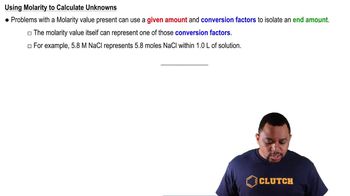
Molarity is a measure of concentration defined as the number of moles of solute per liter of solution. It is expressed in moles per liter (M). In this question, the molarity of NaOCl (0.0985 M) indicates how many moles of bleach are present in a given volume, which is essential for calculating the amount of butanethiol that can react.
Video consigliato:

Stoichiometry

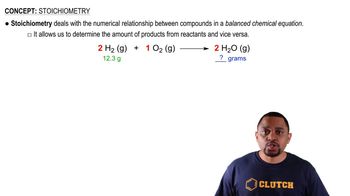
Stoichiometry involves the calculation of reactants and products in chemical reactions based on balanced chemical equations. Understanding the stoichiometric ratios between NaOCl and butanethiol is crucial for determining how much butanethiol can be deodorized by the available bleach, as it allows for the conversion of moles of one substance to moles of another.
Video consigliato:
Percorso guidato
01:16
Stoichiometry Concept

Gravimetric Calculations

Gravimetric calculations involve converting moles of a substance to grams using its molar mass. In this context, once the moles of butanethiol that can react with the available NaOCl are determined, the molar mass of butanethiol (C4H10S) can be used to find the corresponding mass in grams, which is the final answer to the question.
Video consigliato:
Percorso guidato
02:28
Stoichiometric Rate Calculations