
Neither strontium (Sr) nor antimony (Sb) is shown in the activity series of Table 4.5. Based on their positions in the periodic table, which would you expect to be the better reducing agent? Will the following reaction occur? Explain.
Ch.4 - Reactions in Aqueous Solution
Capitolo 4, Problema 120b
Use the activity series of metals (Table 4.5) to predict the outcome of each of the following reactions. If no reaction occurs, write NR. (b)
Guida verificata passo dopo passo1
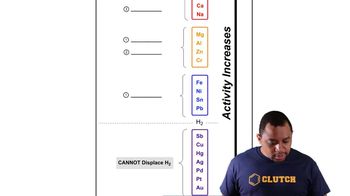
Step 1: Identify the metals involved in the reaction. The activity series of metals is a list of metals ranked in order of decreasing reactivity. The higher a metal is on the list, the more reactive it is.
Step 2: Refer to the activity series of metals (Table 4.5). If the metal in the reactant compound is higher in the activity series than the other metal in the reaction, a reaction will occur. If it is lower, no reaction will occur.
Step 3: If a reaction occurs, write the products of the reaction. The more reactive metal will replace the less reactive metal in the compound.
Step 4: Balance the chemical equation. Make sure the number of atoms for each element is the same on both sides of the equation.
Step 5: If no reaction occurs, write 'NR' for 'No Reaction'. This indicates that the reactants do not interact to form new products.

Risposta video verificata per un problema simile:
Questa soluzione video è stata consigliata dai nostri tutor come utile per risolvere questo problema.
Durata del video:
2mConcetti chiave
Ecco i concetti essenziali che devi comprendere per rispondere correttamente alla domanda.
Activity Series of Metals
The activity series of metals is a list that ranks metals based on their reactivity, with the most reactive metals at the top and the least reactive at the bottom. This series helps predict whether a metal will displace another metal in a chemical reaction. For example, a metal higher in the series can displace a metal lower in the series from its compound.
Video consigliato:
Percorso guidato
Activity Series Chart
Single Replacement Reactions
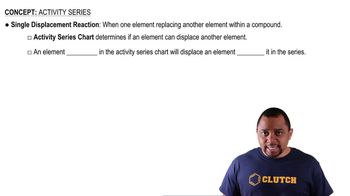
Single replacement reactions occur when one element replaces another in a compound. In these reactions, a more reactive metal can displace a less reactive metal from its compound, leading to the formation of a new compound and the release of the less reactive metal. Understanding this type of reaction is essential for predicting outcomes using the activity series.
Video consigliato:
Percorso guidato
Single Displacement Reactions
No Reaction (NR)
In some cases, when two metals are involved in a potential reaction, no reaction (NR) occurs if the more reactive metal is not present to displace the less reactive one. This outcome indicates that the conditions for a single replacement reaction are not met, and thus, the original compounds remain unchanged. Recognizing when NR applies is crucial for accurately predicting reaction outcomes.
Video consigliato:
Percorso guidato
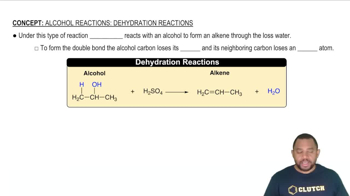
Alcohol Reactions: Dehydration Reactions
Pratica correlata
Domanda del libro di testo
319
views
Domanda del libro di testo
Which element is oxidized and which is reduced in each of the following reactions? (b)
943
views
Domanda del libro di testo
Use the activity series of metals (Table 4.5) to predict the outcome of each of the following reactions. If no reaction occurs, write NR. (a)
426
views
Domanda del libro di testo
Use the activity series of metals (Table 4.5) to predict the outcome of each of the following reactions. If no reaction occurs, write NR. (d)
495
views
Domanda del libro di testo
Which element is oxidized and which is reduced in each of the following reactions? (a)
399
views
Domanda del libro di testo
Use the activity series of metals (Table 4.5) to predict the outcome of each of the following reactions. If no reaction occurs, write NR. (c)
348
views
