Ch.4 - Reactions in Aqueous Solution
McMurry - Chemistry 8th Edition
McMurry8th EditionChemistryISBN: 9781292336145Non è quello che usi tu?Cambia libro di testo
Capitolo 4, Problema 81

Which of the following solutions will not form a precipitate when added to 0.10 M NaOH? (a) 0.10 M MgBr2 (b) 0.10 M NH4Br (c) 0.10 M FeCl2

Guida verificata passo dopo passo
1
Identify the ions present in each solution when dissolved in water: (a) MgBr2 dissociates into Mg^{2+} and 2 Br^{-}, (b) NH4Br dissociates into NH4^{+} and Br^{-}, (c) FeCl2 dissociates into Fe^{2+} and 2 Cl^{-}.
Consider the ions present in the NaOH solution: NaOH dissociates into Na^{+} and OH^{-}.
Determine the possible precipitates by considering the solubility rules: Mg(OH)2 is insoluble, NH4OH is soluble, and Fe(OH)2 is insoluble.
Predict the formation of precipitates: (a) Mg^{2+} + 2 OH^{-} \(\rightarrow\) Mg(OH)2 (precipitate), (b) NH4^{+} + OH^{-} \(\rightarrow\) NH4OH (no precipitate), (c) Fe^{2+} + 2 OH^{-} \(\rightarrow\) Fe(OH)2 (precipitate).
Conclude that the solution that will not form a precipitate when added to 0.10 M NaOH is (b) 0.10 M NH4Br.

Risposta video verificata per un problema simile:

Questa soluzione video è stata consigliata dai nostri tutor come utile per risolvere questo problema.
Durata del video:
10m

Concetti chiave

Ecco i concetti essenziali che devi comprendere per rispondere correttamente alla domanda.

Solubility Rules

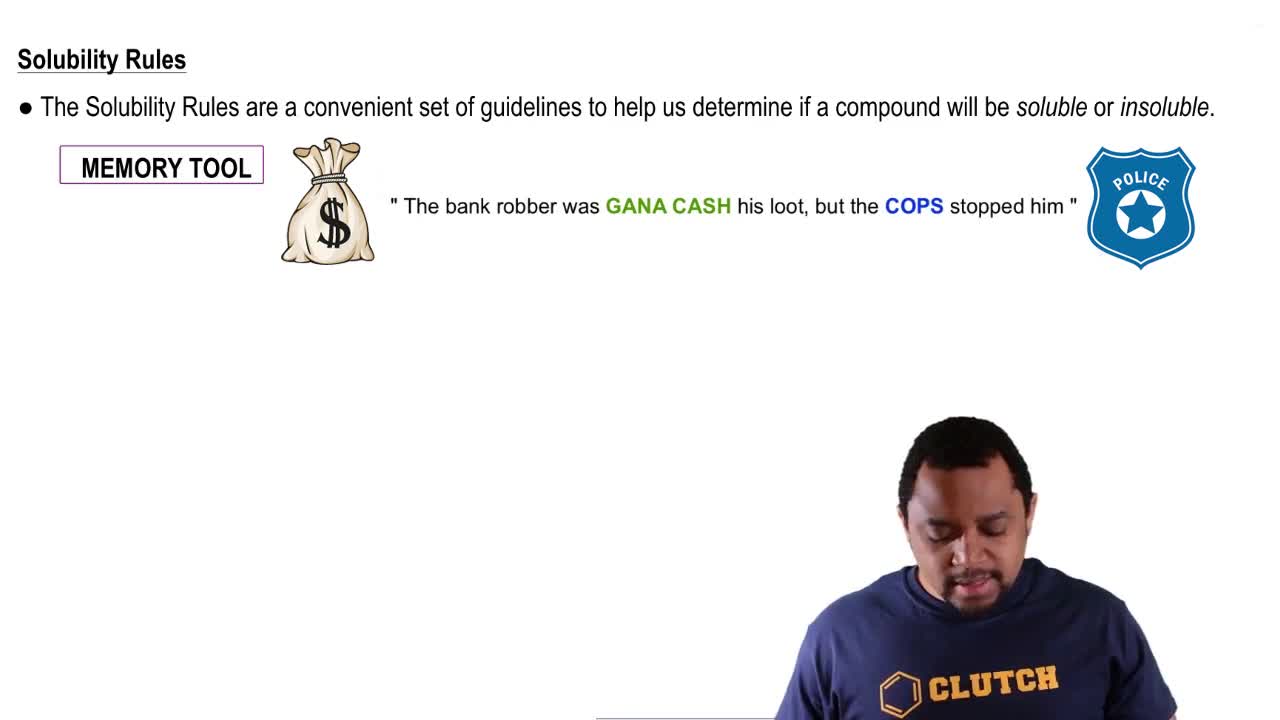
Solubility rules are guidelines that help predict whether a compound will dissolve in water or form a precipitate. For example, most alkali metal salts and ammonium salts are soluble, while many transition metal hydroxides are not. Understanding these rules is essential for determining the outcome of mixing solutions, particularly in the context of precipitation reactions.
Video consigliato:
Percorso guidato
00:28
Solubility Rules

Precipitation Reactions

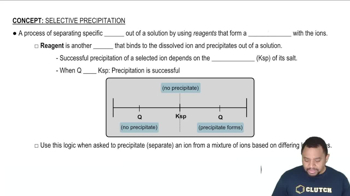
A precipitation reaction occurs when two soluble salts react in solution to form an insoluble compound, known as a precipitate. This process is driven by the formation of a product that is less soluble than the reactants. Identifying the ions present in the solutions and their potential interactions is crucial for predicting whether a precipitate will form.
Video consigliato:
Percorso guidato
01:53
Selective Precipitation

Ion Concentration and Reaction Quotient

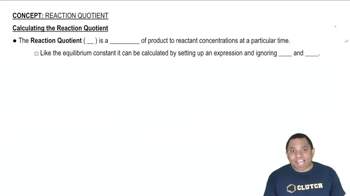
The reaction quotient (Q) compares the concentrations of the products and reactants in a solution. If Q exceeds the solubility product constant (Ksp) for a given compound, a precipitate will form. In this context, understanding the concentrations of ions in the solutions being mixed helps determine if a precipitate will form when NaOH is added.
Video consigliato:
Percorso guidato
00:49
Reaction Quotient Q