
Ch.4 - Reactions in Aqueous Solution
McMurry - Chemistry 8th Edition
McMurry8th EditionChemistryISBN: 9781292336145Non è quello che usi tu?Cambia libro di testo
Capitolo 4, Problema 7

Which of the following solutions will not form a precipitate when added to 10 mL of 0.10 M KOH? (LO 4.10, 4.11) (a) 10 mL of 0.10 NH4Cl (b) 10 mL of 0.10 M PbSO4 (c) 10 mL of 0.10 M Fe(NO3)3 (d) 10 mL of 0.10 M AgCH3CO2

Guida verificata passo dopo passo
1
Identify the ions present in each solution when mixed with KOH: NH4Cl provides NH4^+ and Cl^-, PbSO4 provides Pb^2+ and SO4^2-, Fe(NO3)3 provides Fe^3+ and NO3^-, AgCH3CO2 provides Ag^+ and CH3CO2^-.
Consider the solubility rules to determine if any of the ions will form an insoluble compound with OH^- from KOH.
Recall that most hydroxides are insoluble except those of alkali metals and Ba^2+, Sr^2+, and Ca^2+ to some extent.
Evaluate each combination: NH4^+ with OH^- forms NH3 and H2O, which is soluble; Pb^2+ with OH^- forms Pb(OH)2, which is insoluble; Fe^3+ with OH^- forms Fe(OH)3, which is insoluble; Ag^+ with OH^- forms AgOH, which is insoluble.
Determine which solution does not form a precipitate: NH4Cl does not form a precipitate with KOH, as NH4OH is soluble.

Risposta video verificata per un problema simile:

Questa soluzione video è stata consigliata dai nostri tutor come utile per risolvere questo problema.
Durata del video:
10m

Concetti chiave

Ecco i concetti essenziali che devi comprendere per rispondere correttamente alla domanda.

Precipitation Reactions

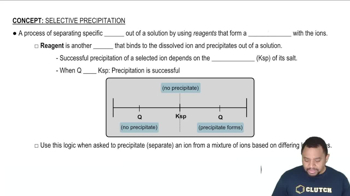
Precipitation reactions occur when two soluble ionic compounds react in solution to form an insoluble compound, known as a precipitate. The solubility of the resulting compounds can be predicted using solubility rules, which state that certain combinations of ions will not dissolve in water. Understanding these rules is essential for determining whether a precipitate will form when mixing solutions.
Video consigliato:
Percorso guidato
01:53
Selective Precipitation

Solubility Product Constant (Ksp)

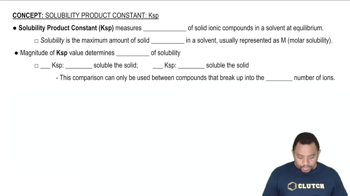
The solubility product constant (Ksp) is a numerical value that represents the equilibrium between a solid and its ions in a saturated solution. It helps predict whether a precipitate will form based on the concentrations of the ions in solution. If the product of the ion concentrations exceeds the Ksp, a precipitate will form; if not, the ions remain in solution.
Video consigliato:
Percorso guidato
01:47
Solubility Product Constant

Common Ion Effect

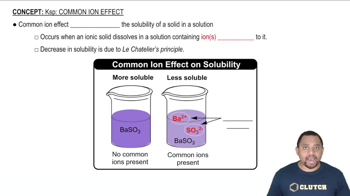
The common ion effect refers to the decrease in solubility of an ionic compound when a common ion is added to the solution. This phenomenon is important in precipitation reactions, as the presence of a common ion can shift the equilibrium, potentially preventing the formation of a precipitate. Recognizing the common ions in the solutions being mixed is crucial for predicting the outcome of the reaction.
Video consigliato:
Percorso guidato
02:53
Common Ion Effect
Pratica correlata
Domanda del libro di testo
When 75.0 mL of a 0.100 M lead(II) nitrate solution is mixed with 100.0 mL of a 0.190 M potassium iodide solu-tion, a yellow-orange precipitate of lead(II) iodide is formed. What is the mass in grams of lead(II) iodide formed? Assume the reaction goes to completion. (LO 4.11, 4.15) (a) 1.729 g (b) 3.458 g (c) 4.380 g (d) 8.760 g
1393
views
1
comments
Domanda del libro di testo
Refer to the figure to answer questions 4 and 5. The images are a molecular representation of three different substances, AX3, AY3, and AZ3, dissolved in water. (Water molecules are omitted for clarity.) What are the molar concentrations of A ions and X ions in a 0.500 M solution of AX3? (LO 4.7) (a) 0.500 M A and 0.500 M X (b) 0.500 M A and 0.167 M X (c) 1.500 M A and 0.500 M X (d) 0.500 M A and 1.500 M X
306
views
Domanda del libro di testo
Write a net ionic equation for the reaction that occurs when 10 mL of 0.5 M ammonium carbonate is mixed with 10 mL of 0.5 M silver nitrate. (LO 4.9, 4.11) (a) (b) (c) (d) A net ionic reaction cannot be written because a reaction does not take place.
557
views
Domanda del libro di testo
Refer to the figure to answer questions 4 and 5. The images are a molecular representation of three different substances, AX3, AY3, and AZ3, dissolved in water. (Water molecules are omitted for clarity.)

Which of the substances is the weakest electrolyte? (LO 4.6) (a) AX3 (b) AY3 (c) AZ3 (d) All of the substances are strong electrolytes.
452
views
Domanda del libro di testo
Which of the following substances will produce a solution that does not conduct electricity when it dissolves in water? (LO 4.6) (a) NaOH (b) HNO3 (c) Na2SO4 (d) CH3OH
1066
views
Domanda del libro di testo
What volume of 0.250 M HCl is needed to react completely with 25.00 mL of 0.375 M Na2CO3? (LO 4.15) (a) 75.0 mL (b) 18.8 mL (c) 37.5 mL (d) 33.3 mL
1023
views