
Ch.4 - Reactions in Aqueous Solution
McMurry - Chemistry 8th Edition
McMurry8th EditionChemistryISBN: 9781292336145Non è quello che usi tu?Cambia libro di testo
Capitolo 4, Problema 99a

Write balanced net ionic equations for the following reactions. Note that HClO3 is a strong acid. (a)

Guida verificata passo dopo passo
1
Identify the reactants and products in the given reaction. Since HClO3 is a strong acid, it will dissociate completely in water.
Write the balanced molecular equation for the reaction. This involves writing the chemical formulas of the reactants and products and balancing the equation with respect to mass and charge.
Dissociate all strong electrolytes (strong acids, strong bases, and soluble salts) into their constituent ions to write the complete ionic equation.
Cancel out the spectator ions that appear on both sides of the complete ionic equation. Spectator ions do not participate in the actual chemical reaction.
Write the net ionic equation, which includes only the ions and molecules directly involved in the chemical change.

Risposta video verificata per un problema simile:

Questa soluzione video è stata consigliata dai nostri tutor come utile per risolvere questo problema.
Durata del video:
5m

Concetti chiave

Ecco i concetti essenziali che devi comprendere per rispondere correttamente alla domanda.

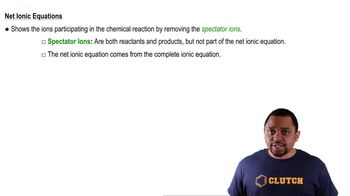
Net Ionic Equations

Net ionic equations represent the actual chemical species that participate in a reaction, excluding spectator ions. They are derived from complete ionic equations by removing ions that do not change during the reaction. This simplification helps to focus on the essential chemical changes occurring in the solution.
Video consigliato:
Percorso guidato
00:51
Net Ionic Equations

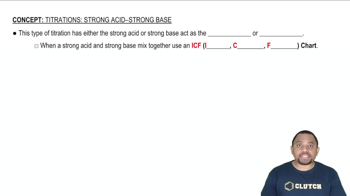
Strong Acids

Strong acids, such as HClO3, completely dissociate in water, releasing all their hydrogen ions (H+) into the solution. This characteristic means that in reactions involving strong acids, the acid can be represented solely by its ions in the net ionic equation, simplifying the process of writing these equations.
Video consigliato:
Percorso guidato
01:09
Strong Acid-Strong Base Titration

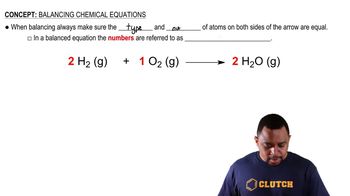
Balancing Chemical Equations

Balancing chemical equations ensures that the number of atoms for each element is the same on both sides of the equation, adhering to the law of conservation of mass. This process involves adjusting coefficients in front of compounds to achieve balance, which is crucial for accurately representing the stoichiometry of the reaction.
Video consigliato:
Percorso guidato
01:32
Balancing Chemical Equations