

Ch.5 - Periodicity & Electronic Structure of Atoms
McMurry - Chemistry 8th Edition
McMurry8th EditionChemistryISBN: 9781292336145Non è quello che usi tu?Cambia libro di testo
Capitolo 5, Problema 47

(c) What is the color of the light with = 450 nm?

Guida verificata passo dopo passo
1
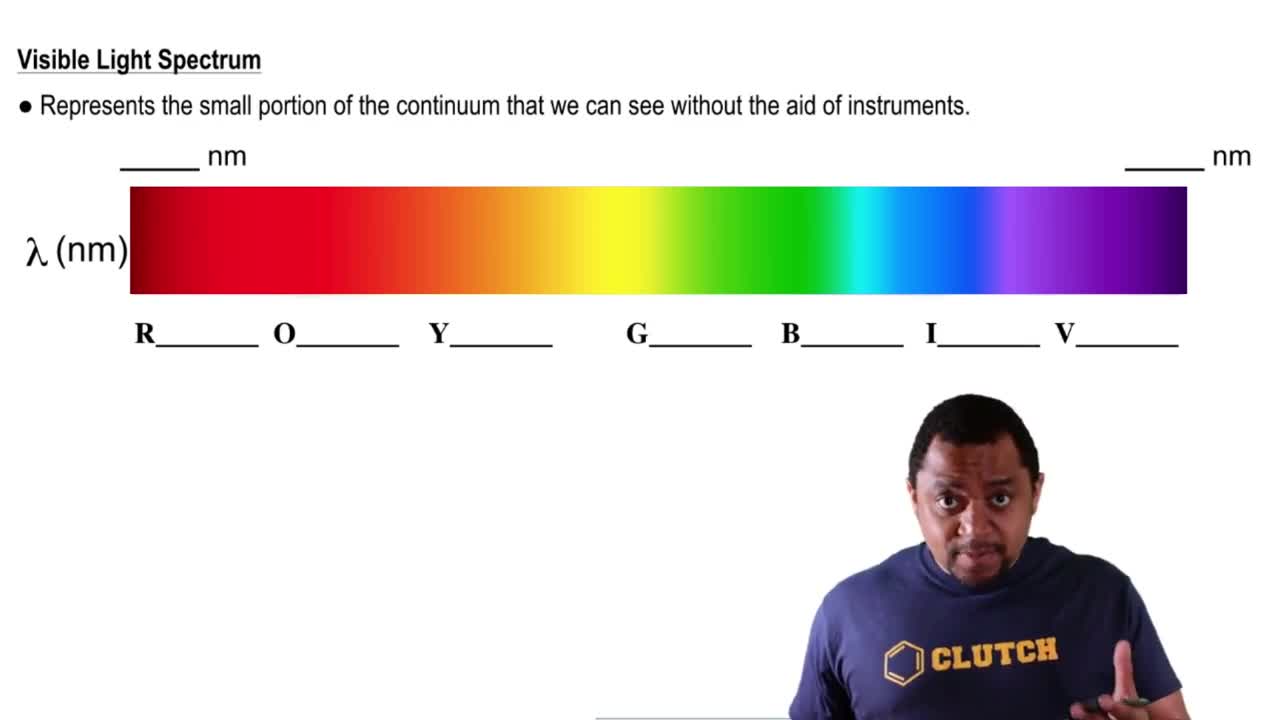
Identify the range of wavelengths for visible light, which is approximately 400 nm to 700 nm.
Determine where 450 nm falls within the visible light spectrum.
Recall the colors associated with different wavelength ranges: violet (400-450 nm), blue (450-495 nm), green (495-570 nm), yellow (570-590 nm), orange (590-620 nm), and red (620-750 nm).
Since 450 nm is at the boundary between violet and blue, consider the dominant color associated with this wavelength.
Conclude the color of light corresponding to 450 nm based on its position in the visible spectrum.

Risposta video verificata per un problema simile:

Questa soluzione video è stata consigliata dai nostri tutor come utile per risolvere questo problema.
Durata del video:
38s

Concetti chiave

Ecco i concetti essenziali che devi comprendere per rispondere correttamente alla domanda.

Wavelength and Color

The wavelength of light, measured in nanometers (nm), determines its color in the visible spectrum. Light with a wavelength of approximately 450 nm falls within the blue region of the spectrum, which ranges from about 450 to 495 nm. Understanding this relationship is crucial for identifying the color associated with specific wavelengths.
Video consigliato:
Percorso guidato
00:31
Frequency-Wavelength Relationship

Visible Spectrum

The visible spectrum is the portion of the electromagnetic spectrum that can be detected by the human eye, typically ranging from about 380 nm (violet) to 750 nm (red). Each color corresponds to a specific range of wavelengths, and knowing the visible spectrum helps in categorizing light based on its wavelength.
Video consigliato:
Percorso guidato
01:24
Visible Light Spectrum

Electromagnetic Spectrum

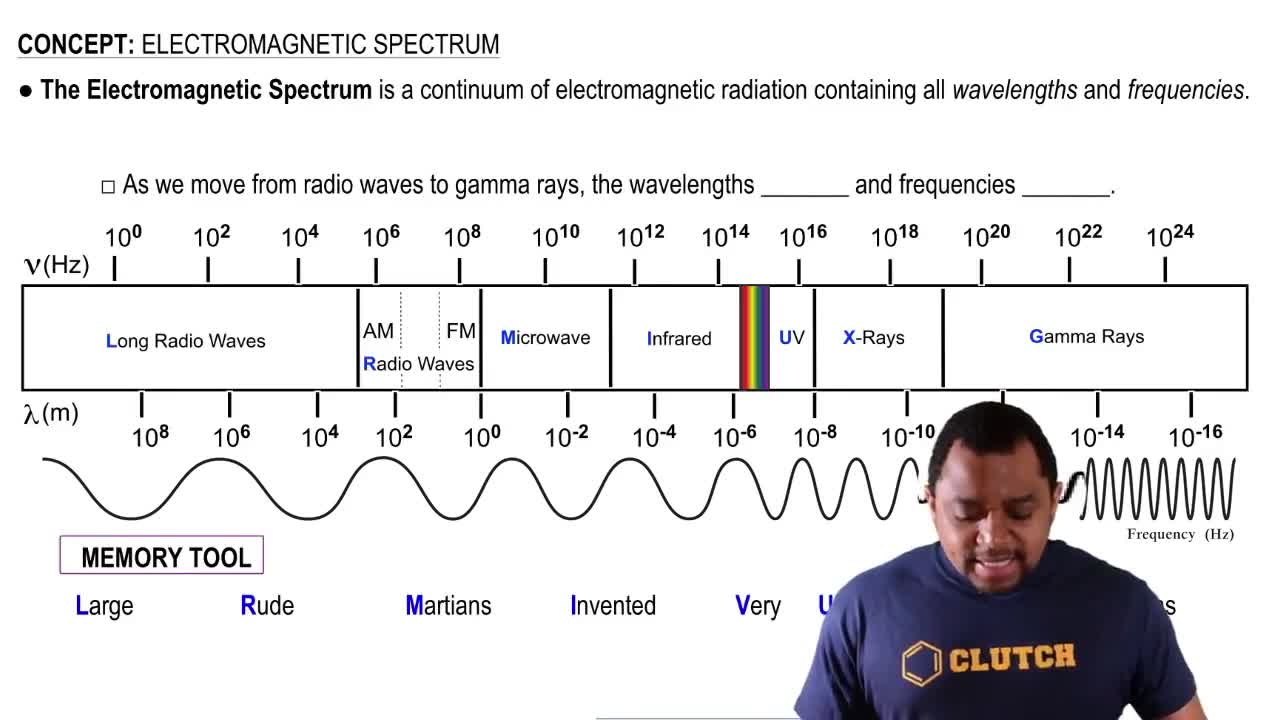
The electromagnetic spectrum encompasses all types of electromagnetic radiation, including visible light, infrared, ultraviolet, and more. Each type of radiation is characterized by its wavelength and frequency. Understanding the broader electromagnetic spectrum provides context for where visible light fits and how it interacts with matter.
Video consigliato:
Percorso guidato
02:53
Electromagnetic Spectrum
Pratica correlata
Domanda del libro di testo
The work function of cesium metal is 188 kJ/mol, which corresponds to light with a wavelength of 637 nm. Which of the following will cause the smallest number of electrons to be ejected from cesium? (a) High-amplitude wave with a wavelength of 500 nm (b) Low-amplitude wave with a wavelength of 500 nm (c) High-amplitude wave with a wavelength of 650 nm (d) Low-amplitude wave with a wavelength of 650 nm
1141
views
Domanda del libro di testo
(c) What type of electromagnetic radiation are these photons?
934
views
Domanda del libro di testo
Calculate the energies of the following waves in kilojoules per mole, and tell which member of each pair has the higher value. (a) An FM radio wave at 99.5 MHz and an AM radio wave at 1150 kHz
937
views
Domanda del libro di testo
What is the energy of each of the following photons in kilojoules per mole? (a) v = 5.97 * 1019 s-1 (b) v = 1.26 * 106 s-1 (c) = 2.57 * 102 m
478
views
Domanda del libro di testo
The work function of silver metal is 436 kJ/mol. What frequency of light is needed to eject electrons from a sample of silver?
1067
views
Domanda del libro di testo
The work function of calcium metal is kJ/mol, which corresponds to light with a wavelength of 432 nm. Which of the following will cause the largest number of electrons to be ejected from cesium? (a) High-amplitude wave with a wavelength of 400 nm (b) Low-amplitude wave with a wavelength of 400 nm (c) High-amplitude wave with a wavelength of 450 nm (d) Low-amplitude wave with a wavelength of 450 nm
1171
views