Ch.5 - Periodicity & Electronic Structure of Atoms
McMurry - Chemistry 8th Edition
McMurry8th EditionChemistryISBN: 9781292336145Non è quello che usi tu?Cambia libro di testo
Capitolo 5, Problema 52

The work function of cesium metal is 188 kJ/mol, which corresponds to light with a wavelength of 637 nm. Which of the following will cause the smallest number of electrons to be ejected from cesium? (a) High-amplitude wave with a wavelength of 500 nm (b) Low-amplitude wave with a wavelength of 500 nm (c) High-amplitude wave with a wavelength of 650 nm (d) Low-amplitude wave with a wavelength of 650 nm

Guida verificata passo dopo passo
1
Understand the concept of the work function: The work function is the minimum energy required to eject an electron from the surface of a metal. It is given in kJ/mol, and for cesium, it is 188 kJ/mol.
Convert the work function to energy per photon: Use the equation E = \(\frac{hc}{\lambda}\) to find the energy of a photon with a wavelength of 637 nm, where h is Planck's constant and c is the speed of light.
Compare the energy of photons with different wavelengths: Calculate the energy of photons with wavelengths of 500 nm and 650 nm using the same equation E = \(\frac{hc}{\lambda}\).
Determine which photons have enough energy to eject electrons: Compare the calculated photon energies to the work function of cesium. Photons with energy greater than or equal to the work function can eject electrons.
Consider the effect of amplitude: Amplitude affects the number of photons, not their energy. Therefore, the wavelength is the determining factor for the number of electrons ejected.

Risposta video verificata per un problema simile:

Questa soluzione video è stata consigliata dai nostri tutor come utile per risolvere questo problema.
Durata del video:
9m

Concetti chiave

Ecco i concetti essenziali che devi comprendere per rispondere correttamente alla domanda.

Photoelectric Effect

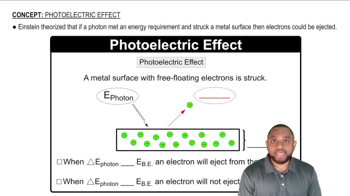
The photoelectric effect is the phenomenon where electrons are emitted from a material when it absorbs light of sufficient energy. The energy of the incoming light is determined by its wavelength, with shorter wavelengths corresponding to higher energy. This concept is crucial for understanding how light interacts with metals and the conditions under which electrons can be ejected.
Video consigliato:
Percorso guidato
02:31
Photoelectric Effect

Work Function

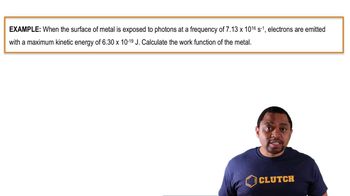
The work function is the minimum energy required to remove an electron from the surface of a material. For cesium, this value is 188 kJ/mol, which translates to a specific wavelength of light that can provide enough energy to overcome this barrier. Understanding the work function helps determine whether a given wavelength of light will result in electron ejection.
Video consigliato:
Percorso guidato
01:52
Work Function Calculation Example

Amplitude of Light Waves

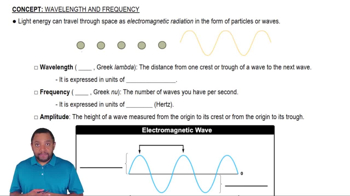
The amplitude of a light wave relates to its intensity or brightness, but it does not affect the energy of individual photons. In the context of the photoelectric effect, while higher amplitude can increase the number of photons hitting the surface, it does not change the energy of each photon. Therefore, the amplitude alone does not determine whether electrons will be ejected, but rather the wavelength and energy of the light are the critical factors.

Video consigliato:
Percorso guidato
2:58
Electromagnetic Waves