Ch.5 - Periodicity & Electronic Structure of Atoms
McMurry - Chemistry 8th Edition
McMurry8th EditionChemistryISBN: 9781292336145Non è quello che usi tu?Cambia libro di testo
Capitolo 5, Problema 28

Identify each of the following orbitals, and give n and l quantum numbers for each. (a) Illustration of orbitals showing angular momentum quantum numbers for quantum mechanics.
(b)

Guida verificata passo dopo passo
1
Identify the shape of each orbital in the image. The left orbital has a cloverleaf shape, which is characteristic of a d-orbital. The right orbital is spherical, which is characteristic of an s-orbital.
For the d-orbital (left), the angular momentum quantum number (l) is 2. The principal quantum number (n) can be any integer greater than or equal to 3.
For the s-orbital (right), the angular momentum quantum number (l) is 0. The principal quantum number (n) can be any integer greater than or equal to 1.
Summarize the quantum numbers for each orbital: (a) d-orbital: n ≥ 3, l = 2; (b) s-orbital: n ≥ 1, l = 0.
Ensure that the quantum numbers are consistent with the shapes and types of orbitals identified.

Risposta video verificata per un problema simile:

Questa soluzione video è stata consigliata dai nostri tutor come utile per risolvere questo problema.
Durata del video:
4m

Concetti chiave

Ecco i concetti essenziali che devi comprendere per rispondere correttamente alla domanda.

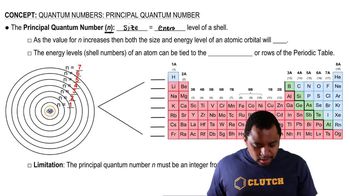
Quantum Numbers

Quantum numbers are a set of numerical values that describe the unique quantum state of an electron in an atom. The four quantum numbers include the principal quantum number (n), which indicates the energy level; the azimuthal quantum number (l), which describes the shape of the orbital; the magnetic quantum number (m_l), which specifies the orientation of the orbital; and the spin quantum number (m_s), which indicates the spin direction of the electron.
Video consigliato:
Percorso guidato
02:55
Principal Quantum Number

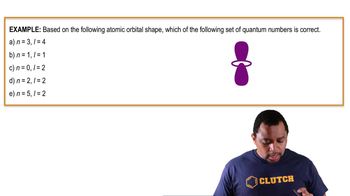
Orbital Shapes

Orbitals are regions in an atom where there is a high probability of finding electrons. Each type of orbital has a distinct shape: s orbitals are spherical, p orbitals are dumbbell-shaped, d orbitals have more complex shapes, and f orbitals are even more intricate. Understanding these shapes is crucial for predicting how atoms will bond and interact with one another.
Video consigliato:
Percorso guidato
01:47
Quantum Numbers and Orbital Shape Example

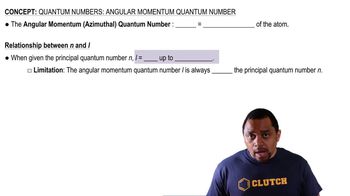
Angular Momentum Quantum Number (l)

The angular momentum quantum number (l) determines the shape of an orbital and can take on integer values from 0 to n-1, where n is the principal quantum number. For example, l = 0 corresponds to s orbitals, l = 1 corresponds to p orbitals, l = 2 corresponds to d orbitals, and l = 3 corresponds to f orbitals. This number is essential for identifying the type of orbital and its associated properties.
Video consigliato:
Percorso guidato
00:40
Angular Momentum Quantum Number