Ch.6 - Ionic Compounds: Periodic Trends and Bonding Theory
McMurry - Chemistry 8th Edition
McMurry8th EditionChemistryISBN: 9781292336145Non è quello che usi tu?Cambia libro di testo
Capitolo 6, Problema 61a

(a) Which has the smaller fourth ionization energy, Sn or Sb?

Guida verificata passo dopo passo
1
Identify the electron configurations of Sn (Tin) and Sb (Antimony) to understand their electronic structures. Sn has the electron configuration [Kr] 4d10 5s2 5p2, and Sb has the electron configuration [Kr] 4d10 5s2 5p3.
Understand the concept of ionization energy, which is the energy required to remove an electron from a gaseous atom or ion. The fourth ionization energy refers to the energy needed to remove the fourth electron.
Analyze the stability of the resulting ion after removing three electrons. For Sn, removing three electrons gives Sn3+, which has an electron configuration of [Kr] 4d10 5s2. For Sb, removing three electrons results in Sb3+ with an electron configuration of [Kr] 4d10 5s2 5p0.
Consider the stability of the electron configuration after the removal of the fourth electron. Sn4+ would have the configuration [Kr] 4d10, which is a stable d10 configuration. Sb4+ would have an electron configuration of [Kr] 4d10 5s1, which is less stable due to the presence of an unpaired electron in the 5s orbital.
Conclude that since Sn4+ results in a more stable electron configuration compared to Sb4+, Sn likely has a smaller fourth ionization energy than Sb. This is because less energy is required to remove an electron that results in a stable electronic configuration.

Risposta video verificata per un problema simile:

Questa soluzione video è stata consigliata dai nostri tutor come utile per risolvere questo problema.
Durata del video:
52s

Concetti chiave

Ecco i concetti essenziali che devi comprendere per rispondere correttamente alla domanda.

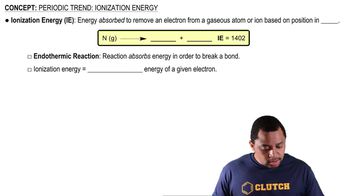
Ionization Energy

Ionization energy is the energy required to remove an electron from an atom or ion in its gaseous state. It is a key factor in determining an element's reactivity and is influenced by the atomic size and the effective nuclear charge. Generally, ionization energy increases across a period and decreases down a group in the periodic table.
Video consigliato:
Percorso guidato
01:19
Ionization Energy

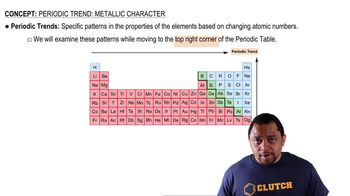
Trends in the Periodic Table

The periodic table exhibits specific trends in properties such as ionization energy, electronegativity, and atomic radius. As you move from left to right across a period, ionization energy tends to increase due to the increasing nuclear charge. Conversely, as you move down a group, ionization energy decreases because of the increased distance between the nucleus and the outermost electrons, which are more shielded by inner electrons.
Video consigliato:
Percorso guidato
00:38
Periodic Trends

Group 14 and Group 15 Elements

Tin (Sn) and antimony (Sb) are elements in groups 14 and 15 of the periodic table, respectively. The fourth ionization energy refers to the energy needed to remove the fourth electron from an atom. Understanding the electronic configurations and the stability of the resulting ions after successive ionizations is crucial for predicting which element will have a lower fourth ionization energy.
Video consigliato:
Percorso guidato
00:50
Main Group Elements: Density Example