Ch.6 - Ionic Compounds: Periodic Trends and Bonding Theory
McMurry - Chemistry 8th Edition
McMurry8th EditionChemistryISBN: 9781292336145Non è quello che usi tu?Cambia libro di testo
Capitolo 6, Problema 59

Order the elements in each set from the smallest to largest first ionization energy. (a) Na, I, P (b) P, Sr, Mg (c) Ca, Cs, Se

Guida verificata passo dopo passo
1
Step 1: Understand the concept of ionization energy, which is the energy required to remove an electron from a gaseous atom or ion. Generally, ionization energy increases across a period (left to right) and decreases down a group (top to bottom) in the periodic table.
Step 2: For set (a) Na, I, P: Locate these elements on the periodic table. Na (Sodium) is in Group 1, I (Iodine) is in Group 17, and P (Phosphorus) is in Group 15. Consider their positions: Na is in Period 3, P is also in Period 3, and I is in Period 5.
Step 3: For set (b) P, Sr, Mg: Locate these elements on the periodic table. P (Phosphorus) is in Group 15, Sr (Strontium) is in Group 2, and Mg (Magnesium) is in Group 2. Consider their positions: P is in Period 3, Mg is in Period 3, and Sr is in Period 5.
Step 4: For set (c) Ca, Cs, Se: Locate these elements on the periodic table. Ca (Calcium) is in Group 2, Cs (Cesium) is in Group 1, and Se (Selenium) is in Group 16. Consider their positions: Ca is in Period 4, Se is in Period 4, and Cs is in Period 6.
Step 5: Apply the periodic trends: For each set, compare the elements based on their group and period positions to determine the order from smallest to largest ionization energy. Remember that elements further to the right and higher up in the periodic table generally have higher ionization energies.

Concetti chiave

Ecco i concetti essenziali che devi comprendere per rispondere correttamente alla domanda.

Ionization Energy

Ionization energy is the energy required to remove an electron from a gaseous atom or ion. It is a key factor in determining an element's reactivity and is influenced by the atomic size and the effective nuclear charge. Generally, ionization energy increases across a period due to increasing nuclear charge and decreases down a group due to increased distance from the nucleus.
Video consigliato:
Percorso guidato
01:19
Ionization Energy

Periodic Trends

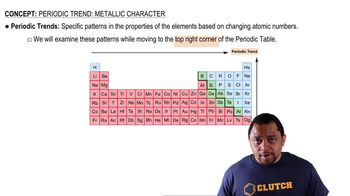
Periodic trends refer to the predictable patterns observed in the properties of elements as you move across periods or down groups in the periodic table. For ionization energy, elements in the same group exhibit decreasing ionization energy down the group, while elements in the same period show increasing ionization energy from left to right. Understanding these trends is essential for predicting the order of ionization energies.
Video consigliato:
Percorso guidato
00:38
Periodic Trends

Atomic Structure

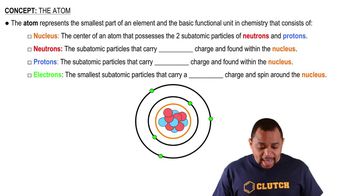
Atomic structure involves the arrangement of protons, neutrons, and electrons within an atom. The number of protons defines the element, while the arrangement of electrons in shells influences chemical properties, including ionization energy. Elements with a full outer shell tend to have higher ionization energies, as their electron configuration is more stable and requires more energy to remove an electron.
Video consigliato: